Cases & Solutions
From One to Five PVC Safety Shoe Injection Machines in India
Since 2010, a Haryana safety footwear manufacturer has expanded from one to five Xingzhong PVC injection machines and helped shape enhanced mould cooling for hot factory conditions.
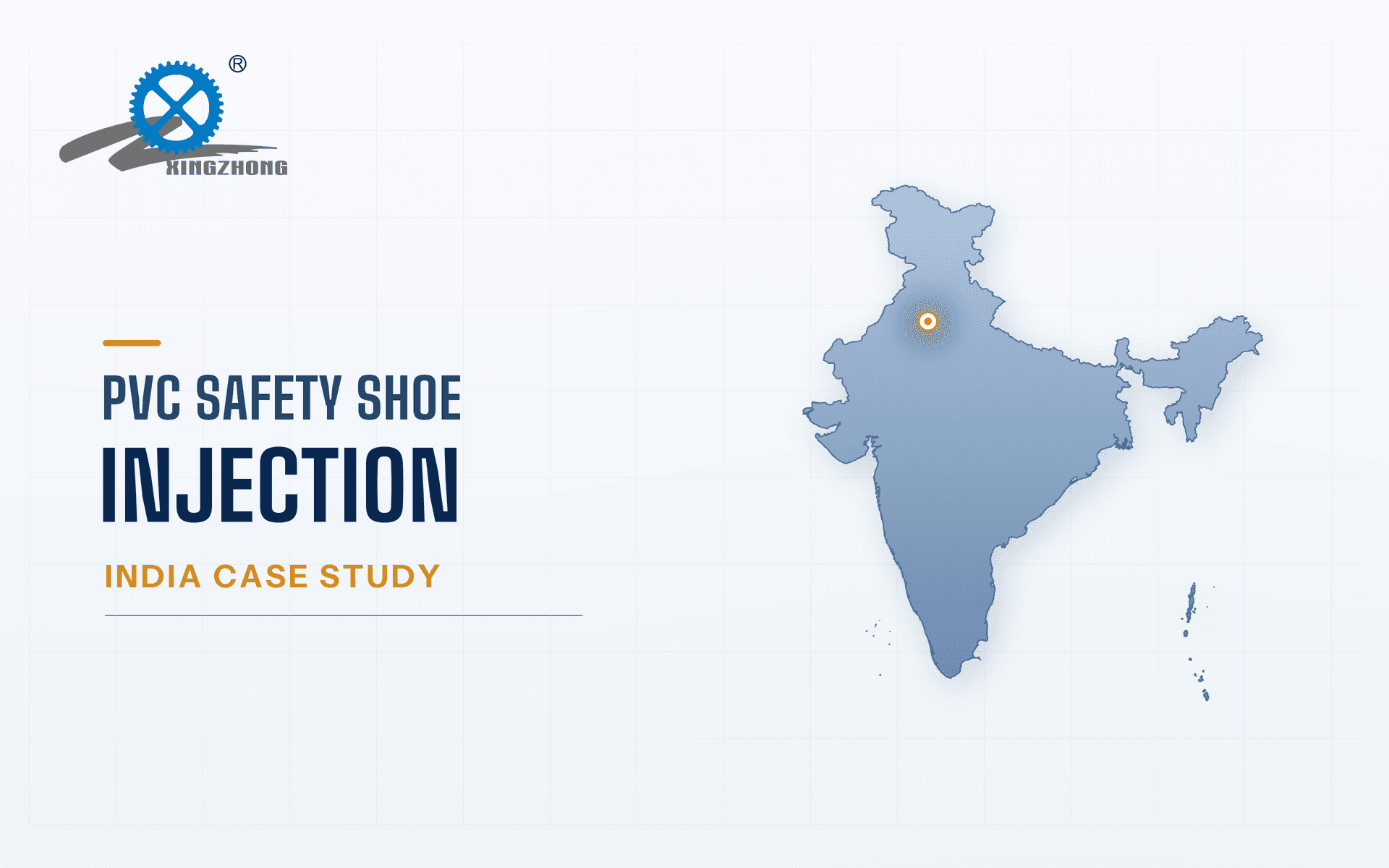
A large safety footwear manufacturer in Haryana, northern India, purchased its first Xingzhong PVC safety shoe injection machine in 2010 and later expanded its purchases to five machines as production demand increased. When the customer asked for faster mould cooling under hot local factory conditions, Xingzhong developed an enhanced mould-cooling function to support a more consistent production rhythm. The cooperation shows how long-term machine performance and direct factory feedback can guide practical equipment development.
A Large Safety Footwear Operation in Haryana
The customer is an established manufacturer of industrial safety footwear and PVC safety boots. Its products are intended for workplaces where foot protection, durability and repeatable quality are central purchasing requirements. At the time of this review, the manufacturer's public materials reported a workforce of more than 800 people and production capacity above 25,000 pairs per day. These figures describe the scale publicly reported by the manufacturer; they are not presented here as independently audited or real-time operating data.
At this scale, safety shoe manufacturing equipment in India becomes part of daily production planning, mould management, maintenance and delivery commitments. Equipment decisions must account for both the product and the environment in which the machine will run.
From the First Machine in 2010 to Five Units
According to Xingzhong's first-party customer records, the manufacturer purchased its first machine from Xingzhong in 2010. As demand and production requirements grew, it placed additional orders over time, bringing the total number purchased to five. This article does not identify individual machine models, installation dates, line configurations or how many units remain in operation today.
The repeat purchases reflect successive production decisions rather than a one-time delivery. Working with a known supplier can simplify communication, technical review and service coordination while giving the machine builder a clearer understanding of the factory's operating priorities.
The Production Challenge: Mould Cooling in Hot Conditions
PVC direct injection footwear production requires the moulded material and tooling to reach suitable conditions before demoulding. Cooling demand can become more noticeable when ambient factory conditions are hot, production runs are long or tooling must handle a repeated cycle. The required cooling time still depends on the product, material formulation, mould design, utilities and operating settings.
In this case, the Haryana customer specifically asked Xingzhong to accelerate mould cooling for its local working conditions. The request was practical: the factory wanted the equipment configuration to respond to the heat experienced during real production. No temperature, cycle-time reduction or output increase has been assigned to the request, so this case does not make a quantified performance claim.
Xingzhong's Engineering Response
Xingzhong responded by developing an enhanced mould-cooling function for the PVC safety shoe injection machine. Its engineering purpose is to support faster heat removal from the mould during the production cycle and make cooling control better suited to demanding factory conditions. The exact circuit, flow, temperature and utility requirements must be confirmed for each machine proposal rather than assumed from this customer story.
This feedback-to-design loop is part of long-term cooperation: the customer reports a repeated constraint and the machine builder reviews it within the complete equipment system. The development is not presented as a patent, an industry first or a guarantee that cooling alone determines output.
Why Stable Mould Cooling Matters at Scale
At large production volumes, stable mould cooling supports predictable station timing. Insufficient cooling can contribute to difficult demoulding, deformation or inconsistent cycle decisions, while excessive cooling can extend the cycle. The target is a controlled window matched to the shoe, compound and mould.
For a manufacturer reporting more than 25,000 pairs of daily capacity, small variations repeated across many cycles can affect scheduling and workflow. Reliable equipment cannot remove every process variable, but it can help reduce avoidable uncertainty when the machine, tooling, material, utilities and operator practice are engineered as one production package.
What This Partnership Shows About Equipment Selection
The history from one machine to five shows the value of matching equipment development to changing production needs. The proof point is the documented purchase sequence since 2010 and the customer's decision to bring a specific factory problem to Xingzhong for engineering review.
For other safety footwear manufacturers, the lesson is to discuss operating conditions before finalizing a PVC direct injection shoe machine. Product drawings and target output matter, but so do ambient heat, shift length, available cooling water, chiller performance, water quality, mould construction and local maintenance capability. These inputs allow a supplier to review the whole system instead of quoting a generic configuration.
Planning a PVC Safety Shoe Injection Project for a Hot Climate
Before requesting a proposal, a factory should prepare enough application data for the supplier to evaluate production and cooling together. Useful information includes:
- Safety shoe or boot samples, drawings, size range, sole volume and target materials.
- Expected pairs per shift, operating hours, changeover pattern and seasonal demand.
- Typical and maximum factory temperatures, ventilation and machine surroundings.
- Cooling-water source, available temperature and flow, water quality and chiller capacity.
- Local voltage, frequency, power stability, floor space and maintenance resources.
- Required quality tests, training, spare parts and after-sales support expectations.
For current product information, review the XZ-988 PVC/TPR direct injection machine and Xingzhong's Direct Injection Process guide. The linked product page describes a current machine range and does not identify the configuration purchased by this anonymous customer.
Frequently Asked Questions
What type of equipment did the Haryana manufacturer purchase?
The manufacturer purchased Xingzhong PVC safety shoe injection machines. Xingzhong's records show one first purchase in 2010 and five machines purchased in total, but this case does not disclose individual models or configurations.
Why was faster mould cooling requested?
The customer requested faster mould cooling in response to the hot conditions experienced at its factory in Haryana. The request led Xingzhong to develop an enhanced cooling function, without attaching an unverified temperature, cycle-time or output claim.
How does mould cooling support PVC safety shoe production?
Mould cooling helps the tooling and injected PVC reach conditions suitable for controlled demoulding and a repeatable cycle. The required cooling window depends on the compound, product, mould, factory environment and available utilities.
Does faster cooling guarantee higher output?
No. Cooling is one production variable. Sellable output also depends on material preparation, injection settings, mould design, loading and unloading, operator balance, maintenance, utilities and quality acceptance.
What should a factory share with Xingzhong before selecting a machine?
Share shoe samples or drawings, material, sizes, target output, shift hours, local climate, voltage and cooling utilities. Contact Xingzhong for a project-specific configuration review.
Sources and Disclosure
- Customer identity is withheld for commercial privacy. The 2010 first purchase and five-machine total are based on Xingzhong's first-party customer records.
- Workforce and capacity figures reflect public materials issued by the manufacturer and reviewed for this case; they are not presented as audited or real-time data. Identifying customer links are intentionally omitted.
- Government of India, Ministry of MSME: Advanced Technologies in Non-Leather Footwear