
Industry News
Direct Injection Process (DIP) in Footwear: How PVC and TPR Soles Are Molded Directly to Uppers
A practical guide to molding PVC and TPR soles directly onto shoe uppers, controlling quality, troubleshooting defects, and selecting a suitable DIP shoe machine.
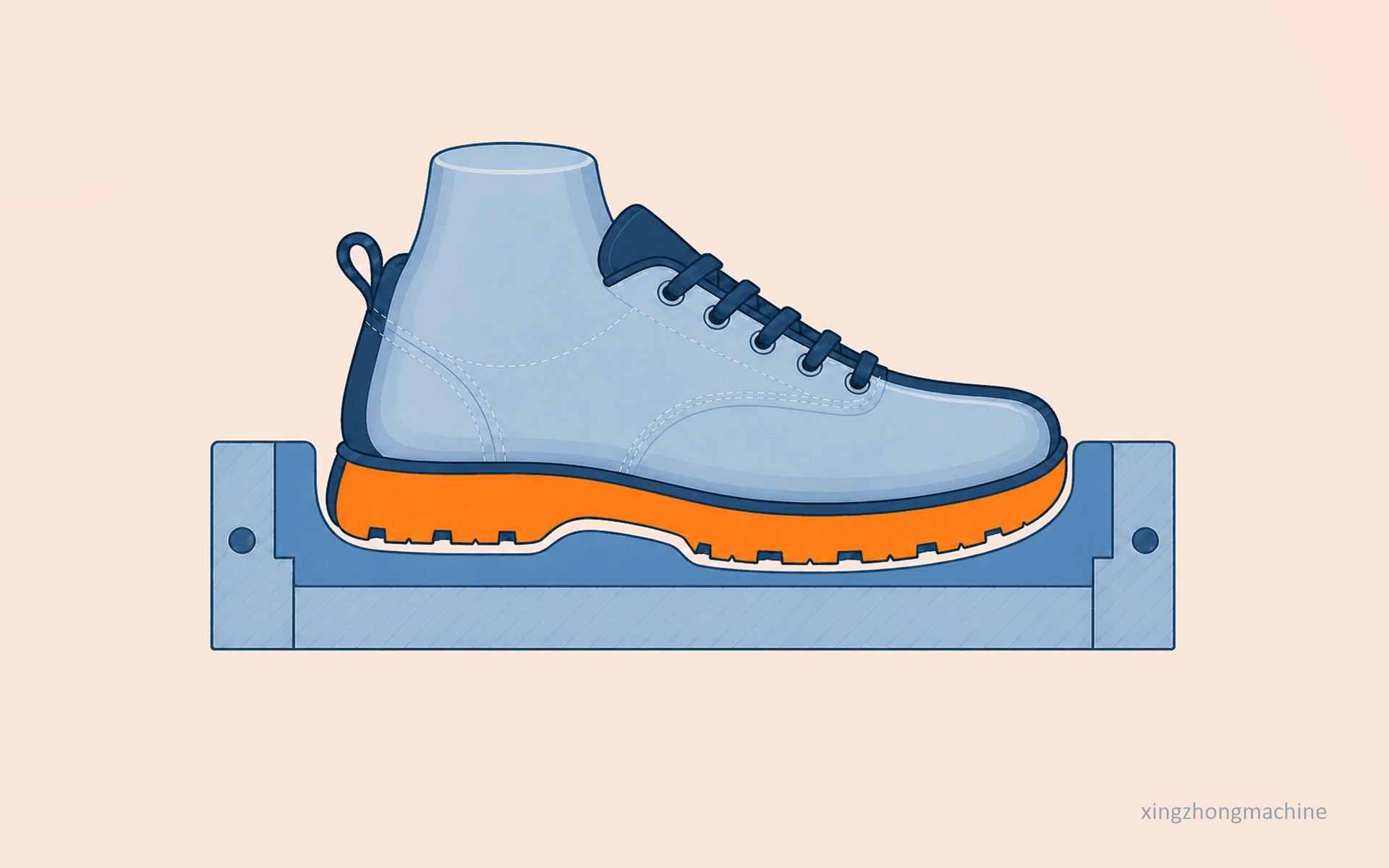
The direct injection process (DIP) is a footwear manufacturing method that forms a sole directly around a lasted upper inside a closed mold. Plasticized PVC or TPR fills the sole cavity, contacts the prepared upper, then cools into shape. The molding cycle forms the sole and its bond in one controlled operation.
DIP combines sole forming and upper-to-sole joining. It can reduce separate attaching operations and improve repeatability when the upper, compound, mold, last, machine settings, and cooling system are engineered as one production package.
What do DIP, direct soling, and direct injection molding mean?
DIP usually means Direct Injection Process or Direct Injection Production. Direct soling describes the same core idea: material enters a mold around the shoe upper, forming the sole directly on the upper instead of attaching a separately molded sole.
The equipment depends on the sole material. Thermoplastic PVC and TPR are plasticized before injection and harden as they cool. Reactive PU uses different metering and mixing equipment. A PVC/TPR machine should not be presented as automatically suitable for PU, TPU, EVA, or rubber.
How does the direct injection shoe-making process work?
- Confirm the shoe construction. The upper, sole geometry, size range, compound, last, and mold interface must be developed as one compatible system.
- Prepare the compound and machine. Approved PVC or TPR material is loaded, while the barrel zones, screw, injection volume, mold cooling, and safety systems are checked for the planned product.
- Last and condition the upper. The upper is fitted accurately to the last. Depending on the textile, synthetic, or leather construction, cleaning, roughing, heat conditioning, primer, or another validated preparation step may be required.
- Position the last and close the mold. The bottom and side mold sections close around the lasted upper. Correct alignment prevents upper damage, uneven sole edges, and excessive flash.
- Inject and control filling. The plasticized material enters the sole cavity. Shot volume, injection speed, pressure, melt condition, gate design, and venting must work together so the cavity fills without burning, trapped air, or distortion.
- Cool while the rotary table indexes. The sole stabilizes as other stations are loaded, injected, opened, or unloaded. This overlapping workflow drives multi-station productivity.
- Demold, finish, and inspect. The shoe is removed, trimmed if needed, and checked for bonding, flash, short fill, bubbles, dimensions, color, surface condition, and left-right consistency before packing or downstream finishing.
PVC vs. TPR for direct injection footwear
Both materials are thermoplastics that can be processed on suitable screw injection equipment, but the compound formulation and target shoe determine the correct choice. The following comparison is a purchasing guide, not a substitute for trials with the actual upper, mold, and material batch.
| Factor | PVC | TPR |
|---|---|---|
| Typical buying priority | Cost control, colorability, water resistance, and broad compound availability | Rubber-like feel, flexibility, grip, and cold-condition performance, depending on formulation |
| Common applications | Casual shoes, sports-style footwear, sandals, slippers, and work footwear | Casual and sports-style shoes, flexible soles, sandals, and applications needing a rubber-like touch |
| Process focus | Stable plasticization, temperature control, venting, and cooling | Material-specific temperature window, shrinkage control, surface finish, and demolding behavior |
| Important caution | Performance varies with plasticizer, filler, foaming, hardness, and compliance requirements | TPR is a broad material family; hardness, rebound, abrasion, grip, and bonding must be confirmed by testing |
Which variables control bonding, appearance, and output?
- Upper compatibility and preparation. Bonding depends on the upper substrate, backing, coatings, seams, moisture, contamination, and the validated preparation method. A strong result on one textile or synthetic leather does not guarantee the same result on another.
- Compound consistency. Hardness, foaming level, color masterbatch, recycled content, storage condition, and batch variation can change flow, cooling, shrinkage, surface quality, and bond performance.
- Melt and injection control. Barrel temperatures, screw recovery, shot size, speed, pressure, and hold behavior must fill the cavity without overheating the material or damaging the upper.
- Mold, gate, and venting design. Balanced flow, effective air release, accurate parting surfaces, and controlled mold temperature help prevent short shots, burns, bubbles, flash, and uneven density.
- Cooling and production rhythm. Insufficient cooling may cause deformation or difficult demolding. Excess cooling can reduce output. Stable water temperature and disciplined station timing matter more than a theoretical maximum speed.
- Alignment and maintenance. Worn locating parts, inconsistent lasting, loose mold hardware, contaminated surfaces, or unstable hydraulic and electrical conditions can create repeating defects.
How does DIP compare with cemented sole construction?
A cemented construction normally molds or purchases the sole separately, prepares both bonding surfaces, applies adhesive, activates it, positions the sole, presses the assembly, and allows the bond to stabilize. DIP forms the sole against the prepared upper during molding, so it can remove several separate attaching operations from the main production route.
Potential benefits include fewer handling steps, continuous rotary production, repeatable sole geometry, a direct molded interface, and less manual sole positioning. However, DIP requires dedicated molds and lasts, compatible materials, controlled utilities, trained operators, and enough volume to justify tooling and changeovers.
It is also safer to describe DIP as reducing or eliminating adhesive at the primary sole-to-upper interface when the validated construction permits it. Some uppers, inserts, decorations, reinforcement parts, or preparation systems may still use primers or adhesives.
Common DIP defects and what to check first
Troubleshooting should change one controlled variable at a time and record the result. Final settings must be approved through sample trials and product testing.
| Symptom | Likely areas to check | First corrective direction |
|---|---|---|
| Short fill or incomplete sole | Shot volume, melt condition, injection speed or pressure, blocked gate, trapped air, flow length | Confirm material feed and actual shot; inspect gates and vents; adjust the validated filling profile incrementally |
| Flash at the parting line | Excess shot or pressure, poor mold closure, worn parting surfaces, misalignment, material too fluid | Verify clamp and mold condition before reducing shot or changing temperature |
| Bubbles, voids, or burn marks | Moisture or volatiles, trapped air, poor venting, excessive temperature or speed | Check compound storage and drying requirements; clean vents; review fill speed and heat history |
| Weak upper-to-sole bond | Incompatible or contaminated upper, incorrect preparation, low contact temperature or pressure, unstable material flow | Run a controlled upper-preparation and material compatibility trial; verify complete filling at the bond interface |
| Warping or dimensional variation | Uneven cooling, early demolding, inconsistent shot, mold temperature imbalance, last or mold alignment | Stabilize cooling and cycle time; verify shot repeatability and tooling alignment |
What should a factory specify before buying a DIP shoe machine?
- Finished shoe samples or drawings, upper materials, sole construction, size range, colors, hardness targets, and whether the sole is solid or foamed.
- Required sellable pairs per shift, expected changeovers, planned efficiency, staffing pattern, and acceptable scrap allowance - not only a headline pairs-per-hour target.
- The number of molds and lasts needed for every size and left-right pair, plus sample approval, mold change, storage, and maintenance arrangements.
- Available voltage, frequency, power stability, cooling-water or chiller capacity, compressed air where required, ventilation, floor loading, equipment access, and safe working clearance.
- Local PVC or TPR sourcing, approved formulations, color control, storage conditions, batch traceability, and access to technical support from the compound supplier.
- Installation, commissioning, operator training, preventive maintenance, critical spare parts, remote support, and overseas service expectations.
- A sample trial using the intended upper, mold, and compound, followed by the factory's required bond, flex, abrasion, slip, aging, waterproof, or safety-footwear tests.
XZ-988 example: translating machine specifications into a production decision
Xingzhong's standard XZ-988 rotary shoe injection molding machine is configured for thermoplastic materials such as foamed or non-foamed PVC and TPR. The current product data lists 20- and 24-station configurations. For the 20-station reference configuration, the machine uses a 75 mm injection screw, provides a maximum injection capacity of 800 cm3 per shot, and lists an injection pressure range of 5-10 MPa.
The published reference productivity for the standard 20-station configuration is 300-400 pairs per hour. This is a machine reference range, not a guaranteed output for every shoe. Sellable production depends on shoe size and sole volume, number of sizes running, solid or foamed compound, cooling time, mold design, upper loading speed, changeovers, operator balance, quality acceptance, and factory utilities.
Review the XZ-988 technical specifications, then share the actual shoe and shift requirements before selecting the station count, molds, auxiliaries, and material package.
Frequently asked questions about the direct injection process
What does DIP mean in footwear manufacturing?
DIP means Direct Injection Process or Direct Injection Production. It forms a sole directly on a positioned shoe upper inside a mold.
Is direct soling the same as DIP?
In most footwear discussions, direct soling refers to the same core process: molding the sole material directly around the upper instead of attaching a separately molded sole.
Which materials can be used for DIP shoes?
The wider footwear industry uses several material systems, but each requires compatible equipment. Xingzhong's current XZ-988 pages specify thermoplastic PVC and TPR, including foamed and non-foamed applications.
Does DIP footwear use no glue at all?
The primary sole-to-upper interface can be formed during molding, reducing or eliminating cementing there when the construction is validated. Other components or upper-preparation systems may still use primer or adhesive.
What shoes can a PVC/TPR DIP machine produce?
Applications can include casual shoes, sports-style shoes, work or safety footwear, sandals, and slippers. Suitability depends on the upper, compound, sole design, mold, last, and machine configuration.
What determines the actual pairs per hour?
Station count is only one factor. Sole volume, cooling time, shoe sizes, compound, mold design, loading and unloading speed, changeovers, operator balance, utilities, and quality yield all affect sellable output.
Can one DIP machine produce many styles and sizes?
Yes, within the machine's material and dimensional limits, but every style and size requires compatible molds, lasts, process parameters, and changeover planning.
What should I send when requesting a machine quotation?
Send shoe samples or drawings, upper and sole materials, size range, colors, sole weight or volume, target pairs per shift, available power and cooling, factory layout, and required testing or service support.
Plan the machine, mold, material, and process together
A successful DIP project starts with the shoe, not the machine nameplate. Xingzhong can review your upper, sole design, sizes, target output, factory utilities, molds, and PVC/TPR material requirements as one production package. See how a returning customer completed a PVC DIP machine installation in Kandy, then contact Xingzhong to discuss your direct injection shoe production project.
Sources
- Xingzhong - XZ-988 Rotary Type Shoe Injection Molding Machine
- Xingzhong - Rotary Shoe Injection Molding Machines
- DESMA - Direct Soling
- Government of India, Ministry of MSME - Advance Technologies in Non-Leather Footwear
- Google Patents - Footwear and a Method for Manufacturing Footwear Using Direct Injection Process