Industry News
When Is PVC Direct Injection Suitable for School Shoe Production?
Assess when PVC direct injection suits school shoe production, from upper compatibility and repeat orders to process control and finished-shoe quality.
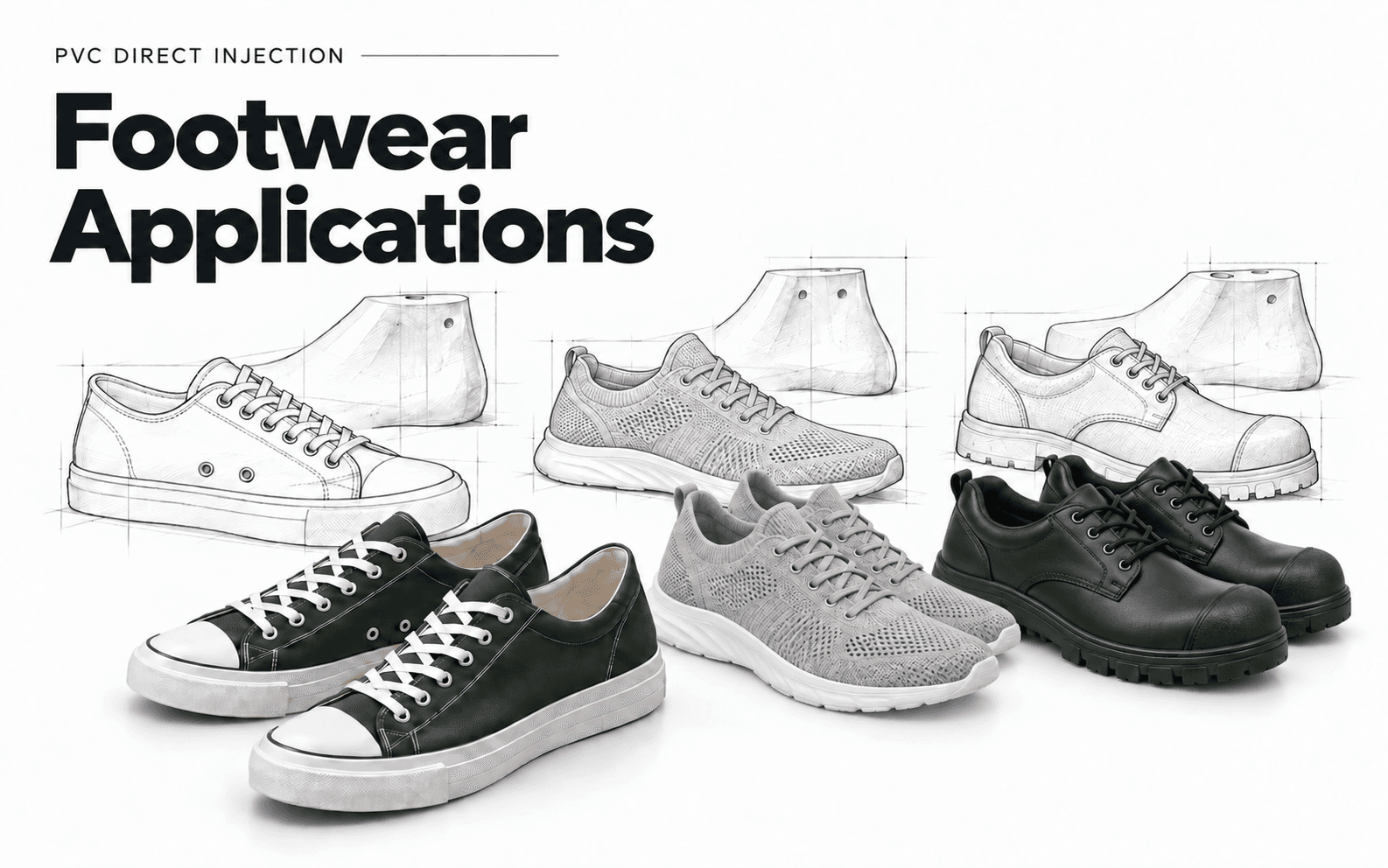
PVC direct injection is suitable for school shoe production when the upper and sole compound have been validated together, orders justify dedicated tooling, the factory can maintain consistent process conditions, and finished shoes meet the buyer’s quality requirements. Repeat orders and predictable size demand make production planning easier, but neither volume nor machine specifications can replace testing.
The Direct Injection Process (DIP) forms the sole directly against a prepared upper inside a mold. This combines sole molding and attachment in one operation. Xingzhong’s direct injection process guide explains the production sequence and the variables that influence the result.
For manufacturers considering PVC direct injection school shoes, the decision should cover materials, order patterns, process control and finished-shoe performance. The following framework helps determine whether a proposed production package is ready for a trial or needs further development.
Material Compatibility: Uppers and PVC Compounds
Validate the complete upper
An upper described simply as “synthetic leather” or “canvas” does not provide enough information to approve direct injection. Backing, coatings, seam construction and the material presented at the sole interface can differ between suppliers and batches.
The upper must tolerate the molding conditions and remain accurately positioned. Dirt, inconsistent moisture or unsuitable surface treatments can interfere with repeatability. Depending on the construction, the validated preparation procedure may include cleaning, conditioning, roughing or primer application.
Use production-representative uppers during trials. Record the supplier, material specification, backing and preparation method. If one of these changes, review whether the original approval still applies. A successful sample does not automatically qualify every visually similar upper.
Match the PVC compound to the specification
PVC formulations can differ in hardness, density, flexibility and processing behavior. Select the compound against the approved school shoe specification and confirm its performance in the finished shoe.
Control any permitted additions, including colorants or reprocessed material, through documented instructions. Avoid treating an unrecorded mixture as equivalent to the approved compound.
Trial results should cover molding appearance, upper-to-sole bonding and the required performance tests. Direct injection should not be advertised as universally “glue-free” or incapable of separation: preparation treatments and other shoe components may still involve adhesives, and bond quality requires verification.
Order Conditions: Repeatability, Sizes and Production Runs
PVC direct injection deserves consideration when a manufacturer expects repeat production of established school shoe lines. Reusing validated molds, lasts, compounds and settings can reduce the development work needed for subsequent orders.
Evaluate the order by size, rather than considering only the total number of pairs. A large order spread across many sizes may require different tooling quantities and production scheduling from an equally large order concentrated in a few sizes.
Before selecting a configuration, establish:
- Expected pairs per size and the balance between initial deliveries and replenishment.
- Which styles will repeat and how often specifications change.
- How frequently molds, sizes or colors must change.
- The delivery window, including any concentration of orders before school terms begin.
Small orders are not automatically unsuitable. Existing compatible tooling and repeat demand may make them practical. However, frequent new styles, uncertain size distribution and repeated setup work require closer evaluation.
There is no universal minimum order quantity for PVC direct injection school shoes. Assess tooling expenditure, changeover time, trial requirements and expected repeat orders together. Production promises should use achievable output of acceptable pairs, with time allowed for inspection and ordinary interruptions.
Factory Conditions: Consistent Process Control
Match the machine, molds and lasts
The injection machine must accommodate the tooling and supply the required material under controlled conditions. Molds and lasts must align correctly, position the upper securely and reproduce the approved fit and sole interface.
Xingzhong’s XZ-988 rotary shoe injection molding machine offers a reference for discussing PVC/TPR machine specifications. Suitability for a particular school shoe should be established through tooling review and trials with the intended materials.
Keep upper preparation consistent
Purchased uppers need the same attention to incoming quality as uppers produced internally. Variation in dimensions, stitching or preparation can become a positioning or bonding problem at injection.
Operators should follow an approved method for fitting the upper to the last and checking its position before molding. Written instructions and reference samples help keep different shifts aligned.
Control injection and cooling
Maintain approved settings for material preparation, temperature, filling and cooling. Insufficient cooling can affect demolding and dimensional stability; unnecessary cooling time reduces output.
Record settings together with the material batch, mold identification and inspection results. When defects appear, investigate systematically rather than changing several variables without documentation.
Evaluate capacity through representative production runs. Station count alone does not account for loading, unloading, size changes, cooling requirements or rejects. The useful measure is consistent output of conforming pairs over the planned working period.
Quality Requirements: What to Validate Before Mass Production
Agree on the product specification, test methods and acceptance criteria before approving production. A laboratory can help select methods appropriate to the shoe and intended market. The following checks address different risks; passing one does not establish overall suitability.
Upper-to-sole bonding. Check attachment strength using a method suitable for the construction. Where specified, assess performance after conditioning or flexing. SATRA describes completed-footwear sole adhesion testing, including assessment at the toe and heel, in its guide to sole testing equipment.
Flexing and abrasion. Evaluate resistance to repeated bending and sole wear. Use the buyer’s agreed methods and limits rather than treating material hardness or a brief manual bend as evidence of durability.
Slip resistance. Test the finished sole under defined surface and contamination conditions relevant to use. SATRA’s TM144 method measures footwear-floor friction under specified conditions. PVC material identification alone cannot establish grip.
Sizing and comfort. Check the completed size range, left-right consistency and fit against approved samples. Include wear or fitting assessments appropriate to the intended users. A well-molded sole does not by itself confirm comfortable footwear.
Climate and moisture exposure. Define any conditioning and performance checks needed for the destination climate. If water resistance is claimed, test the complete construction: water can enter through uppers, seams or openings even when the sole material resists water.
Material safety. Confirm the buyer’s restricted-substance requirements and applicable destination-market obligations with a qualified testing provider. Obtain relevant supplier documentation and test evidence for the approved materials. There is no single worldwide “school shoe certification” that can replace a market-specific assessment.
A Practical Suitability Checklist
Use this table to structure discussions between production, purchasing, quality staff and the equipment supplier.
| Assessment area | Conditions supporting suitability | Conditions needing further validation |
|---|---|---|
| Upper and compound | Actual material combination passes trials | Changed coating, backing, compound or preparation |
| Orders and sizes | Repeat demand and a workable size schedule | Frequent redesigns or uncertain size distribution |
| Tooling | Molds and lasts match the machine and approved sample | Unverified interfaces or inconsistent upper positioning |
| Process control | Repeatable preparation, injection and cooling | Unexplained variation between batches or shifts |
| Finished-shoe quality | Representative shoes meet agreed criteria | Untested bonding, wear, grip, fit or material requirements |
The checklist is a screening tool, not production approval. Retain an approved reference sample, the agreed specification and the corresponding process records. Review changes that could affect performance before applying them to customer orders.
To assess a project, send Xingzhong your school shoe sample, upper material details, size range, order schedule and quality requirements. Contact Xingzhong to discuss machine and tooling compatibility and the information needed for a production trial.
Frequently Asked Questions
Is PVC direct injection suitable for all school shoes?
No. Suitability depends on the actual materials, tooling, production conditions and performance requirements. The school shoe label alone is insufficient. Evaluate representative trial shoes against the buyer’s specification before approving a manufacturing process.
Can PVC soles be directly injected onto synthetic leather or canvas uppers?
They can be suitable, provided the specific upper and PVC compound work together. Coatings, backing, seams and preparation can affect results. Approval should be based on the actual production materials and finished-shoe testing, not the generic upper description.
Is PVC direct injection suitable for small school shoe orders?
It can be, particularly when compatible tooling already exists and repeat orders are expected. For new styles, consider tooling, trials and changeovers alongside the order quantity. There is no single minimum volume that applies to every factory.
Are PVC direct injection school shoes waterproof and slip-resistant?
Neither property is automatic. Whole-shoe water resistance depends on the complete construction. Slip resistance depends on the compound, tread and contact conditions. Support any claim with appropriate testing of the finished product.
What should be tested before starting mass production?
Validate upper-to-sole bonding, flexing, abrasion, slip resistance, sizing and fit, plus any required climate, water-resistance and material-safety checks. Agree on methods and limits with the buyer, using representative materials and recording the approved production settings.