
Cases & Solutions
Why Direct Injection Shoe Machines Benefit from Water-Cooled Servo Motors
Water-cooled servo motors provide a controlled thermal path for repetitive injection duty in direct injection shoe machines. This guide explains the selection logic, limits, cooling requirements and the configuration used by Xingzhong.
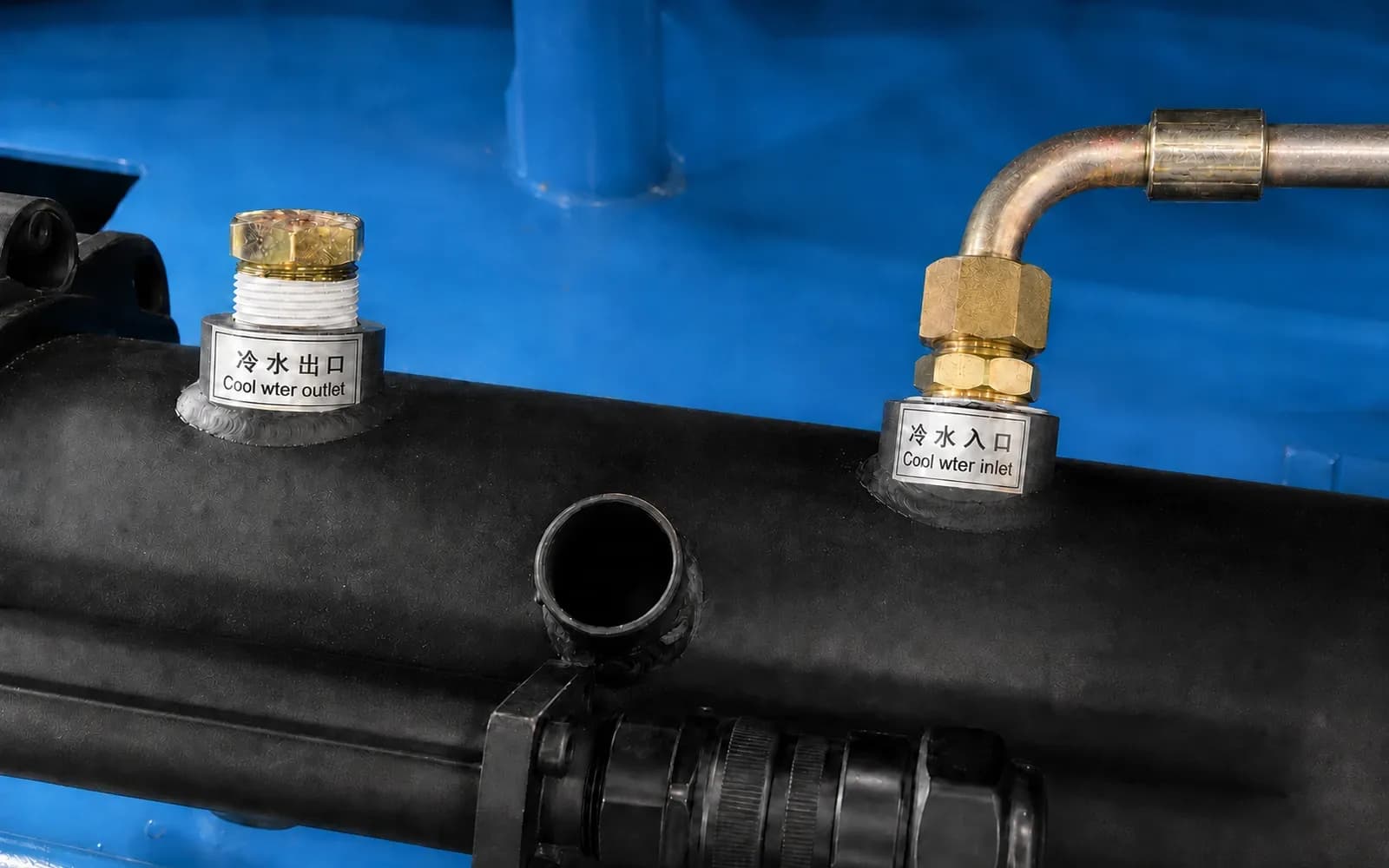
This guide is written for footwear factory owners, production engineers and equipment buyers comparing injection-system configurations.
What Does the Servo Motor Control During Injection?
In a servo-hydraulic direct injection shoe machine, the servo motor drives the hydraulic pump that supplies controlled pressure and flow for the injection cycle. The control system changes motor speed and torque as the process moves through material preparation, pressure build-up, injection, pressure holding, and return. The motor is therefore part of a variable-duty system rather than a simple constant-speed drive.
The injection action is demanding because pressure and flow requirements change quickly. A stable servo system must respond to those commands without allowing motor temperature, hydraulic-oil temperature, or protection limits to interrupt the cycle. The motor, drive, pump, hydraulic circuit, sensors, and cooling loop should be evaluated as one system; selecting the motor by nameplate power alone can miss the real thermal duty.
For buyers, the practical question is not only whether the machine has a servo motor. It is whether the selected motor and its cooling method can deliver the required continuous torque across the actual cycle, material, station count, ambient temperature, and operating hours.
Why Is Injection a Thermally Demanding Motion?
Injection combines repeated acceleration, pressure build-up, holding periods, and frequent starts and stops. When the cycle repeats for many hours, winding and drive losses accumulate even if each individual peak is brief. Low-speed operation can be especially important because the motor may need substantial torque while producing less self-generated airflow than it would at higher speed.
The surrounding machine also contains heat sources, including barrel heaters, plasticized material, hydraulic oil, and electrical equipment. In a warm factory or a compact enclosure, the air available to cool the motor may already be hot. Shoe fibers, dust, oil mist, and release-agent residue can further reduce the performance of a fan, filter, or heat-sink surface over time.
Continuous torque is the torque that a motor can sustain without exceeding its thermal limit under stated cooling conditions. Peak torque is a short-duration capability and cannot be treated as a continuous rating. Kollmorgen's technical discussion of continuous ratings explains that a servo motor's continuous limit is tied to allowable motor temperature and continuous current, while current INVT servo documentation separates continuous and short-time operating regions on torque-speed curves.
Supporting sources: Kollmorgen: continuous ratings and continuous loads | INVT servo product catalog
How Do Air-Cooled and Water-Cooled Servo Motors Differ?
An air-cooled servo motor transfers heat to surrounding air through its housing, fins, and usually a fan or external airflow. A water-cooled servo motor transfers heat into coolant circulating through a motor jacket or internal cooling passage. The key difference is the heat-removal path, not the basic function of the servo motor.
Air cooling is simpler and normally costs less to install. It avoids pumps, hoses, coolant quality controls, and leak checks. Its performance, however, depends heavily on ambient air temperature, airflow clearance, fan condition, and surface cleanliness. A clogged filter or dust-coated heat sink can reduce cooling without changing the commanded production cycle.
Water cooling adds a coolant circuit but provides a more controlled thermal path. It can support higher continuous torque density, reduce dependence on airflow around the motor, and stabilize the temperature of a motor installed near other heat sources. Siemens describes compact water-cooled torque motors as providing high continuous torque density and stable continuous operation; Beckhoff publishes required flow, pressure, and inlet-temperature data for individual water-cooled servomotors, demonstrating that cooling conditions are part of the rating rather than an optional afterthought.
Supporting sources: Siemens: water-cooled torque motor design | Beckhoff: published water-cooling requirements
Why Is Water Cooling Better Suited to Direct Injection Shoe Machines?
Water cooling is generally better suited to the injection action because it removes heat consistently during repetitive, high-load production. The benefit is strongest when the machine runs long shifts, the servo motor operates at low speed with high torque, the motor sits inside a warm enclosure, or airborne contamination makes fan cooling less reliable.
A controlled coolant loop also gives the machine builder more freedom to manage power density and installation space. Instead of relying on a large volume of clean air around the motor, the design carries heat to a chiller or heat exchanger. This can make thermal performance more predictable across seasons and factory layouts, provided the specified coolant temperature and flow are maintained.
Water cooling should not be described as an automatic energy-saving feature. Energy performance depends mainly on the complete servo-hydraulic system, control strategy, pump efficiency, pressure demand, cycle profile, and machine condition. Water cooling protects thermal margin and continuous output; it may reduce the need for forced ventilation or prevent heat-related derating, but those effects are not the same as a guaranteed reduction in electricity consumption.
What Specifications Matter More Than Peak Power?
Continuous torque, the torque-speed curve, and the real duty cycle matter more than peak power when selecting an injection servo motor. Peak ratings show what the system can produce briefly; they do not show whether the motor can repeat the full injection cycle through a long shift without exceeding its thermal limits.
A useful selection review should include the required pressure and flow at each phase, motor speed, continuous and peak torque, cycle time, shots per hour, holding duration, material type, station count, ambient temperature, enclosure conditions, coolant inlet temperature, and coolant flow. The servo drive's continuous current and overload limits must also match the motor and pump.
Buyers should ask for the motor's torque-speed curve under the proposed cooling condition, not a generic family brochure. They should also confirm which temperature sensor and protection logic are used, how a low-flow or high-temperature condition is detected, and whether the machine control records or displays the fault clearly.
What Does a Reliable Water-Cooling System Require?
A reliable water-cooled servo installation requires the correct coolant, flow, pressure, inlet temperature, hose routing, seals, and monitoring. The motor manufacturer's limits should govern the design. Cooling-tower water should not be sent directly through a motor jacket unless the motor supplier explicitly permits it; a closed loop or isolated heat exchanger usually offers better control of contamination and corrosion.
The inlet temperature must also be managed in relation to the factory dew point. Coolant that is too cold can create condensation on the motor, fittings, cables, or nearby electrical components. Coolant that is too warm, or flow that is too low, reduces the continuous rating. Flow and temperature alarms should stop or limit operation before thermal protection is repeatedly triggered.
Routine maintenance should check coolant level and quality, hose abrasion, fitting tightness, leaks, flow, filters, pump operation, chiller cleanliness, and evidence of scale or corrosion. Maintenance personnel should also distinguish the servo-motor cooling loop from mould cooling: sharing equipment or coolant is acceptable only when flow, temperature, cleanliness, and material compatibility meet both circuits' requirements.
Supporting source: Beckhoff example: flow, pressure and inlet-temperature specifications
Why Xingzhong Uses Water-Cooled Servo Motors for Injection
Ruian Xingzhong Industrial Co., Ltd. uses water-cooled servo motors for the injection action in its relevant direct injection shoe machine range. This is an engineering configuration choice intended to provide stable thermal management during repetitive injection duty, particularly where long operating hours, low-speed torque demand, machine heat, and factory contamination can reduce the consistency of air cooling.
The exact servo-motor power, drive rating, pump match, coolant flow, pressure, and temperature range are not identical across every machine. Xingzhong confirms those values in the technical proposal according to the machine model, material, station configuration, required output, local voltage and frequency, ambient conditions, and the buyer's production schedule.
This first-party configuration statement should be read as a machine-system recommendation, not as a claim that water cooling solves every process issue. Stable production also depends on correct screw and barrel settings, hydraulic maintenance, material preparation, mould temperature control, electrical supply quality, and trained operation.
A Practical Checklist for Machine Buyers
A machine buyer should request enough operating data to compare thermal capacity, not just component brands. The supplier should be able to explain how the injection load was calculated and how the cooling system protects continuous production under the buyer's actual factory conditions.
- Define the shoe material, product type, station count, target pairs per hour, and daily operating hours.
- Request continuous and peak torque data across the required motor-speed range.
- Confirm the assumed ambient temperature and whether the motor is installed in an enclosure.
- Record coolant type, inlet-temperature range, required flow, pressure limit, and alarm logic.
- Check whether the motor-cooling circuit is independent from mould cooling or formally engineered for sharing.
- Ask how fan, pump, filter, hose, chiller, and coolant maintenance will be handled locally.
- Require the final motor, drive, pump, voltage, and cooling configuration in the quotation or technical agreement.
Review the XZ-988 rotary shoe injection molding machine or request a machine configuration review.
Frequently Asked Questions
These answers summarize the main selection and maintenance points for the injection servo system.
Which servo motor cooling type is better for direct injection shoe machines?
A water-cooled servo motor is generally the better choice for the injection action of a direct injection shoe machine that runs long shifts or carries a high average load. It provides a more controlled heat-removal path and is less dependent on clean, cool airflow around the motor.
Why does the injection motion create a high thermal load?
The injection cycle repeatedly combines acceleration, pressure build-up, holding, and return. Repeating these demands through a long shift accumulates motor and drive losses, while barrel heaters, hydraulic oil, and a warm enclosure raise the surrounding temperature.
Does a water-cooled servo motor automatically save more electricity?
No. Water cooling primarily improves heat removal and continuous operating margin. Energy use depends on the complete servo-hydraulic system, pump efficiency, control strategy, pressure demand, cycle profile, and machine condition.
Why should buyers compare continuous torque instead of only peak power?
Peak ratings apply for limited periods. Continuous torque shows what the motor can sustain under defined cooling conditions without exceeding its thermal limit, so it is more useful for evaluating repetitive production over a full shift.
What maintenance does a water-cooled servo system require?
Maintenance should cover coolant level and quality, hoses, fittings, leaks, filters, pump operation, flow, inlet temperature, chiller cleanliness, scale, corrosion, and condensation risk. Alarm and interlock functions should also be tested periodically.
Does Xingzhong use air-cooled or water-cooled servo motors for injection?
Ruian Xingzhong Industrial Co., Ltd. uses water-cooled servo motors for the injection action in its relevant direct injection shoe machine range.
Sources and Technical Review Basis
This article combines first-party machine-configuration experience from Xingzhong Technical Team with official motor-manufacturer guidance. The external sources support general principles of continuous ratings, torque-speed operating regions and water-cooling requirements; they do not certify a specific Xingzhong machine configuration.
- Siemens, SIMOTICS T Torque Motors - water-cooled design and continuous torque density
- Beckhoff, AM8354 water-cooled servomotor - published coolant flow, pressure and inlet-temperature data
- Kollmorgen, The Difference Between Continuous Ratings & Continuous Loads
- INVT, Servo Products Comprehensive Catalog - continuous and short-time torque-speed regions
How This Article Was Prepared
The article was prepared around the actual decision a footwear producer must make: whether the injection duty can be sustained under the intended production schedule and factory conditions. Claims were limited to established motor-selection principles, official manufacturer documentation, and Xingzhong's stated machine configuration. No unsupported efficiency, output, lifetime, or failure-rate figures were added.