
Cases & Solutions
PVC Direct Injection Shoe Machine for a Turkish Customer
A Gaziantep customer purchased one Xingzhong PVC direct injection shoe machine in 2018. This case explores the customer background and CE documentation considerations for machinery imports into Turkey.
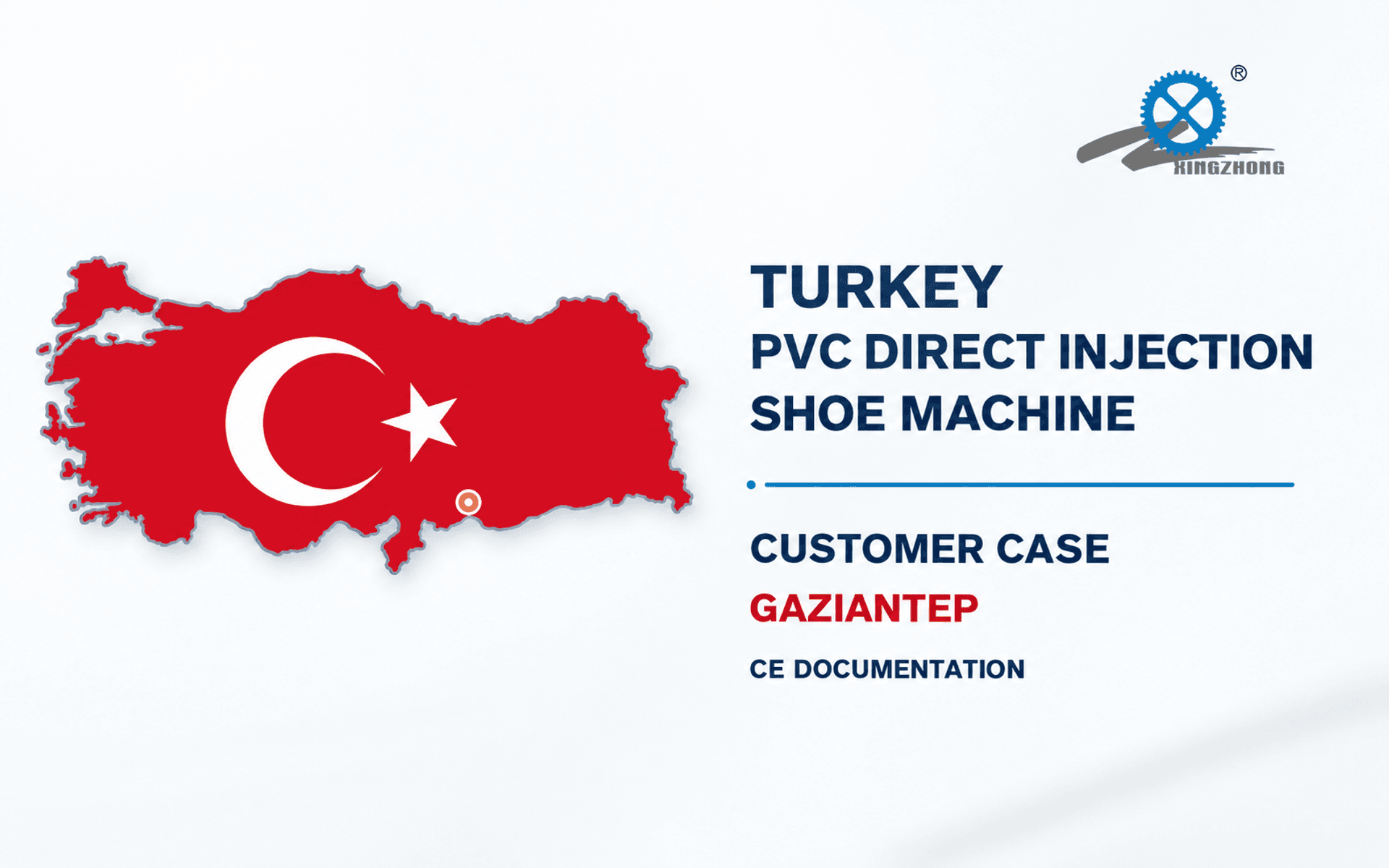
In 2018, a customer in Gaziantep, southeastern Turkey, purchased one Xingzhong PVC direct injection shoe machine. The project included a requirement for CE documentation suitable for Turkish import compliance. For footwear manufacturers considering equipment from overseas, this case illustrates why the machine specification and its conformity documentation should be discussed together, before shipment arrangements are finalised.
As the exporter, our responsibility was to address the customer’s requirement for appropriate CE documentation. This account focuses on the purchase and that requirement, with the customer’s identity kept confidential.
A manufacturing customer in Gaziantep
The customer combines a chemical materials background with footwear manufacturing. Its publicly described activities include PVC compounds and footwear such as work shoes and boots. Earlier official business records classified the company as a small or medium-sized enterprise. That historical classification provides a useful indication of business scale; it does not establish the company’s current workforce or production capacity.
The company’s published history places its entry into footwear before the 2018 equipment purchase. Its broader product range describes the business across time, rather than a confirmed snapshot of the factory in 2018. For this case, the relevant background is an established industrial business with both materials knowledge and a footwear operation in southeastern Turkey.
The 2018 purchase and export requirement
The purchase covered one Xingzhong PVC direct injection shoe machine. Alongside the equipment, the customer required CE documentation that would meet the applicable Turkish import requirements. This made conformity evidence a practical part of the export discussion.
For a procurement team, even a single-machine order deserves an agreed document schedule. The buyer needs to know which documents will accompany the equipment, who is responsible for preparing them and how they relate to the machine being purchased. These questions are especially useful when technical specifications and customs paperwork are handled by different people.
The lesson for similar projects is to include documentation in the purchase scope early. A statement such as “CE certificate required” should be translated into named documents and an assessment route appropriate to the equipment.
How PVC direct injection shoemaking works
A PVC direct injection shoe machine forms the PVC sole directly onto a prepared shoe upper positioned in a mould. The process brings sole formation and attachment to the upper into the same manufacturing operation. It differs from producing a separate sole and attaching it later.
For a buyer, suitability depends on the intended footwear, upper construction, PVC compound and mould design. Sample evaluation should therefore form part of equipment selection. The machine purchased in this case was a PVC direct injection shoe machine; specific compound formulations and machine configurations should be agreed for each application.
When discussing a new project with Xingzhong, start with the shoe you intend to make. Share its construction, size range and planned output so that the technical discussion can address the actual application.
CE documentation for machinery imported into Turkey
Turkey’s official product rules database identifies CE marking under its Machinery Safety Regulation, 2006/42/AT, published in 2009. This provides the relevant machinery framework for discussing a 2018 purchase. Current guidance is useful for explaining terminology, but later import procedures should not be presented as the rules applied to this historical shipment. [1]
CE marking is the marking placed on the equipment to indicate conformity with applicable requirements. A Declaration of Conformity is the manufacturer’s signed legal declaration. A third-party certificate, where required by the applicable conformity assessment procedure, serves a different role. The Turkish Ministry of Trade explains that third-party involvement depends on the relevant technical legislation. [2]
Under the corresponding 2006/42/EC machinery framework, the document is called an EC Declaration of Conformity. Classification matters: Annex IV includes certain plastics injection or compression moulding machinery with manual loading or unloading. The applicable route depends on the machine and relevant standards; neither mandatory third-party certification nor unrestricted self-declaration should be assumed for every shoe machine. [3]
Documents to clarify before shipment
For a new purchase, we recommend agreeing the following review points with the manufacturer, Turkish importer and customs representative. These are procurement checks, not a record of documents issued for the 2018 machine.
- Machine identification: reconcile the manufacturer, model and serial number across the machine plate, declaration and commercial documents.
- Conformity evidence: establish the applicable regulations, the assessment procedure and any certificate required under that procedure.
- Supporting technical information: confirm responsibility for the technical file, risk assessment and relevant test evidence. The full technical file is not automatically a routine shipment enclosure. [3]
- Instructions and import paperwork: agree the Turkish-language documentation required for the destination, plus invoice, packing list and any applicable import-control documents.
Import controls also depend on the tariff classification and rules in force when the goods enter Turkey. The Ministry’s current guidance describes a separate machinery import inspection communiqué for 2026. That is a reason to recheck each new order rather than reuse a historical document list. CE documentation alone does not guarantee customs release. [4]
Frequently asked questions
Is a CE certificate the same as a Declaration of Conformity?
No. The declaration records the manufacturer’s conformity statement; a third-party certificate relates to a particular assessment activity or procedure. Ask for the exact document name, issuer and machine coverage instead of relying on the general phrase “CE certificate”. [2]
Does CE marking on a shoe machine certify the shoes it makes?
No. Machinery conformity and finished-footwear conformity are separate matters. A manufacturer producing protective footwear must assess the footwear against its own applicable product requirements. The machine’s CE marking does not establish the finished shoe’s protective performance. [5]
Can a 2018 document list be reused for a new Turkish order?
Use it as a reference, then verify the new machine, its classification and the import rules applying at shipment. The importer and customs representative should confirm the required submission documents for that specific order. [4]
Discuss your footwear project with Xingzhong
The 2018 Gaziantep purchase connects a concrete equipment decision with an equally practical export requirement: appropriate CE documentation. For a new PVC direct injection shoe machine project in Turkey, contact Xingzhong with your footwear samples or drawings, proposed PVC compounds and destination requirements. We can use that information to discuss equipment suitability and the documentation scope with your team before you commit to a purchase.
Regulatory references
[1] Turkish Ministry of Trade — Machinery legislation
[2] Turkish Ministry of Trade — CE marking
[3] EUR-Lex — Directive 2006/42/EC, Article 12 and Annexes II, IV and VII
[4] Turkish Ministry of Trade — Product groups subject to import inspection
[5] European Commission — Personal protective equipment
References accessed 11 September 2026. Current guidance is identified separately from the historical purchase.