
Industry News
PVC Foamed Sole Weight Variation in Direct Injection Footwear: What to Check
Troubleshoot PVC sole weight variation in direct injection footwear. Check weighing, dosing, foaming, temperatures and station differences before adjusting.
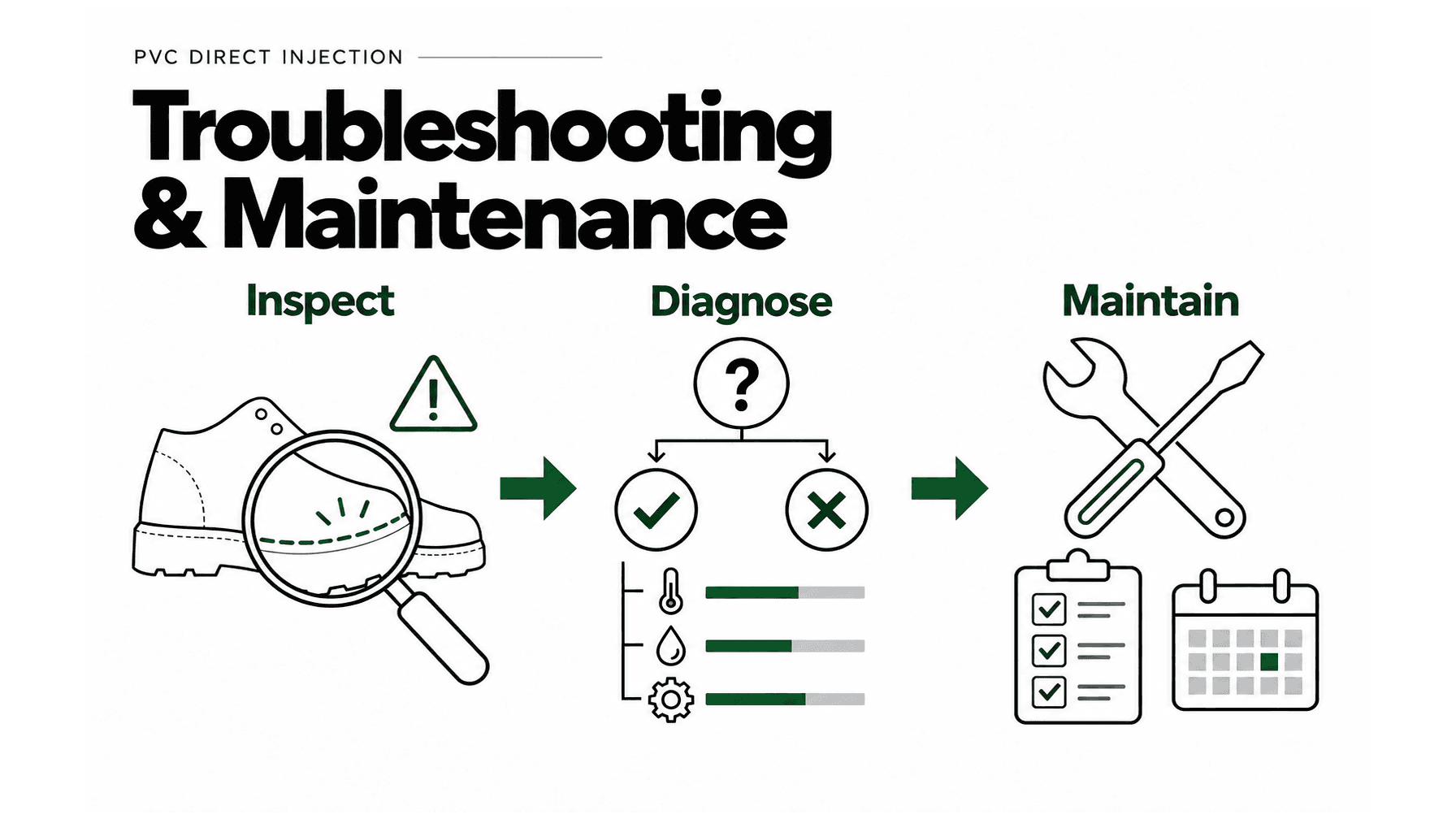
For unstable foamed PVC sole weight, first verify weighing conditions, then check actual shot delivery, compound consistency, melt temperature, injection settings and differences between molding stations. Compare equivalent shoes before changing parameters. A heavier finished shoe does not necessarily have a heavier sole, and identical dosing settings do not prove identical material delivery.
In direct injection processing (DIP), the sole forms directly against the lasted upper. This adds upper weight, last position and assembly variation to the investigation. This guide focuses on chemically foamed PVC; gas-injection systems also require gas-metering checks. For process background, see Xingzhong's direct injection footwear guide.
First establish a reliable weight measurement
Compare the same style, size, side and sole construction. Keep cooling time, trimming condition and attached components consistent. Check scale repeatability by weighing the same sample several times; choose a resolution suitable for the agreed product tolerance.
Finished-shoe weight includes the upper, insole and other components. Where practical, identify each assembly and weigh it before injection, without the last, then weigh the corresponding cooled, trimmed shoe. The difference estimates net mass added during molding. It is not an exact isolated-sole measurement: moisture loss from the upper or changed components can affect it. Record trimming losses separately when investigating material delivery.
Apparent density means mass divided by the foam's external volume, including its cells. Expansion changes volume and density; it does not itself remove the mass of an injected charge. Record dimensions alongside weight rather than treating every weight change as a foaming problem.
Eight parameter groups to check
Use this checklist to compare actual production records, not only saved recipes. Parameter names and available measurements depend on the injection unit.
| Check | Parameters or observations | Diagnostic purpose |
|---|---|---|
| 1. Compound and foaming system | Grade, batch, additive dosing, blending, regrind | Identify material changes |
| 2. Dosing and shot delivery | Recovery endpoint, injection stroke/time, final position, leakage | Check delivery repeatability |
| 3. Barrel and nozzle temperatures | Set/actual temperatures, melt condition, residence time | Identify thermal drift |
| 4. Screw speed and back pressure | Speed, back pressure, recovery time, decompression | Check plasticizing consistency |
| 5. Injection speed and pressure | Filling profile, actual fill time, pressure limit, transfer/end condition | Identify restricted or inconsistent filling |
| 6. Holding or supplementary feed | Pressure, duration, whether enabled | Assess added material and cell compression |
| 7. Mold temperature and cycle | Station temperatures, cooling, closed-mold time, interruptions | Identify unequal thermal history |
| 8. Last, upper and mold | Position, thickness, closure, gates, vents, flash | Check cavity and sealing differences |
Material consistency comes before recipe changes
Confirm whether the compound already contains its foaming system. Do not add more blowing agent simply because a premixed grade produces heavy soles. For separately dosed additives, verify the approved ratio and blending uniformity. Check regrind proportion and processing history, and investigate feed interruptions or bridging. Compare suspect batches against an approved batch under controlled conditions.
Verify what the injection unit actually delivers
Trend dosing endpoints, injection endpoints and filling times. Inspect nozzle leakage and inconsistent feeding. On machines equipped with a non-return valve and measurable melt cushion, check their behavior against the machine manufacturer's procedure. A position reading alone cannot distinguish all possible delivery losses. ENGEL's process-optimization guidance identifies feeding problems and wear in the non-return valve, screw or barrel among relevant checks for cushion instability. These checks apply only where that hardware is fitted.
Separate heater settings from actual melt conditions
Compare actual zone temperatures with their setpoints, including after interruptions. Review screw speed, back pressure and residence time together. Alphagary's flexible PVC guide explains that melt temperature depends on heater settings, screw speed and back pressure. Teknor Apex's processing guide also emphasizes PVC's thermal and shear sensitivity. Neither document supplies a universal recipe for foamed DIP soles; use the specific compound's processing window.
Assess filling and foaming together
Check whether actual filling time changes or the machine reaches its pressure limit. Compare injection-end or transfer conditions rather than automatically increasing pressure. Review holding or supplementary feed against the approved foamed-sole process: added material and pressure can change both weight and cellular structure.
Avient's chemical-foaming guide describes how gas dispersion, melt conditions and pressure affect foam formation, and how holding pressure can suppress expansion. It is general foaming guidance, not a PVC footwear recipe. Do not transfer its numerical settings or assume every DIP process requires zero holding pressure.
Compare stations under equivalent conditions
Check mold temperatures, cooling and actual time before opening. Confirm last height, upper seating, insole thickness and repeatable closure. Inspect gates, vents and flash. These are practical DIP diagnostic checks: a station-specific weight difference should prompt comparison of local tooling and assembly conditions before a machine-wide adjustment.
Let the variation pattern guide the investigation
The following patterns suggest where to start; they do not establish a cause by themselves.
- Random variation at one station: examine feeding, dosing, leakage and injection repeatability; then check assembly placement and weighing.
- The same stations remain heavy or light: compare their stored settings, molds, lasts, temperatures and closure. Keep size and left/right groups separate.
- A shift after changing material: verify grade, batch, blending and regrind before altering the process to compensate.
- Gradual drift during production: compare thermal stabilization, residence time, cycle interruptions and, on hydraulic machines, oil-temperature trends.
- Weight changes with dimensions or cell appearance: investigate shot delivery and foaming conditions together. Compare equivalent sections; one visible bubble is not a density measurement.
- Finished-shoe weight varies but paired mass gain is stable: investigate upper and component variation before changing sole settings.
A machine average can hide opposite trends at different stations. Plot or list each station separately, then check whether the timing of a shift matches a material change, stop or adjustment. This preserves the distinction between a shared injection problem and a local tooling or assembly problem.
For each sample, record the molding and weighing times and keep its station identity through trimming. Photograph flash before removal. This helps distinguish extra material outside the intended sole from material retained in it. Retain light, typical and heavy samples for comparison at the same sole sections. Also label measurements as setpoints or actual readings: a pressure ceiling is not necessarily the pressure reached during filling. Without these distinctions, apparently matching records can describe different molding conditions.
Validate adjustments with a controlled production check
- Establish a baseline. After stable operation, retain identified samples from several complete rotary cycles. Separate restart samples from steady production.
- Record comparable data. Include style, size, side, station, batch, paired mass gain, trimming condition, dosing endpoint, filling time, temperatures and cycle time. Mark unavailable measurements rather than inventing them.
- Change one factor. Choose it from the observed pattern and remain within approved material and machine limits. Record the adjustment and allow stabilization before sampling again.
- Check the full result. Compare both average weight and spread by station. Inspect dimensions, cell structure, surface condition and upper-to-sole bonding against the approved sample and product specification.
Use a consistent sample count and measurement method before and after adjustment. If weight improves but bonding or dimensions deteriorate, the change has not solved the production problem. Restore the validated baseline before testing another explanation.
Frequently asked questions
Why can weight vary when the dosing position is unchanged?
The dosing position describes machine motion, not a direct measurement of finished-sole mass. Feeding, melt condition, leakage, applicable valve behavior and subsequent feeding stages can affect delivery. First rule out weighing and upper-weight differences, then compare actual cycle records.
Will more blowing agent always make the sole lighter?
No. Lower apparent density depends on the compound, gas generation and retention, expansion conditions and the amount injected. Extra additive alone does not guarantee a lighter acceptable sole. Follow the compound supplier's formulation and validate dimensions and performance as well as weight.
Why are only certain rotary stations affected?
Persistent local differences can point to station settings, mold temperature, tooling, last position or upper seating. Compare equivalent sizes and sides. A shared injection unit does not make every station's cavity, cooling and assembly conditions identical.
Do foamed PVC soles need holding pressure?
There is no universal answer. Excessive holding can restrict cell expansion, but the required filling and bonding process depends on the compound, tooling and machine sequence. Review the validated recipe instead of applying a blanket rule to increase or eliminate holding pressure.
Discuss your production records with Xingzhong
For help narrowing down PVC sole weight variation, contact Xingzhong with the machine model, compound grade, size range, affected stations and consecutive-cycle records. Include labeled sample photographs and note whether you measured finished-shoe weight or paired mass gain. This gives the investigation a useful starting point.