Industry News
Which Machine Should You Choose for PVC Direct Injection Footwear
Learn how to select PVC direct-on-upper equipment by matching shoe construction, compound, tooling, cooling, staffing, and trial results to your production target.
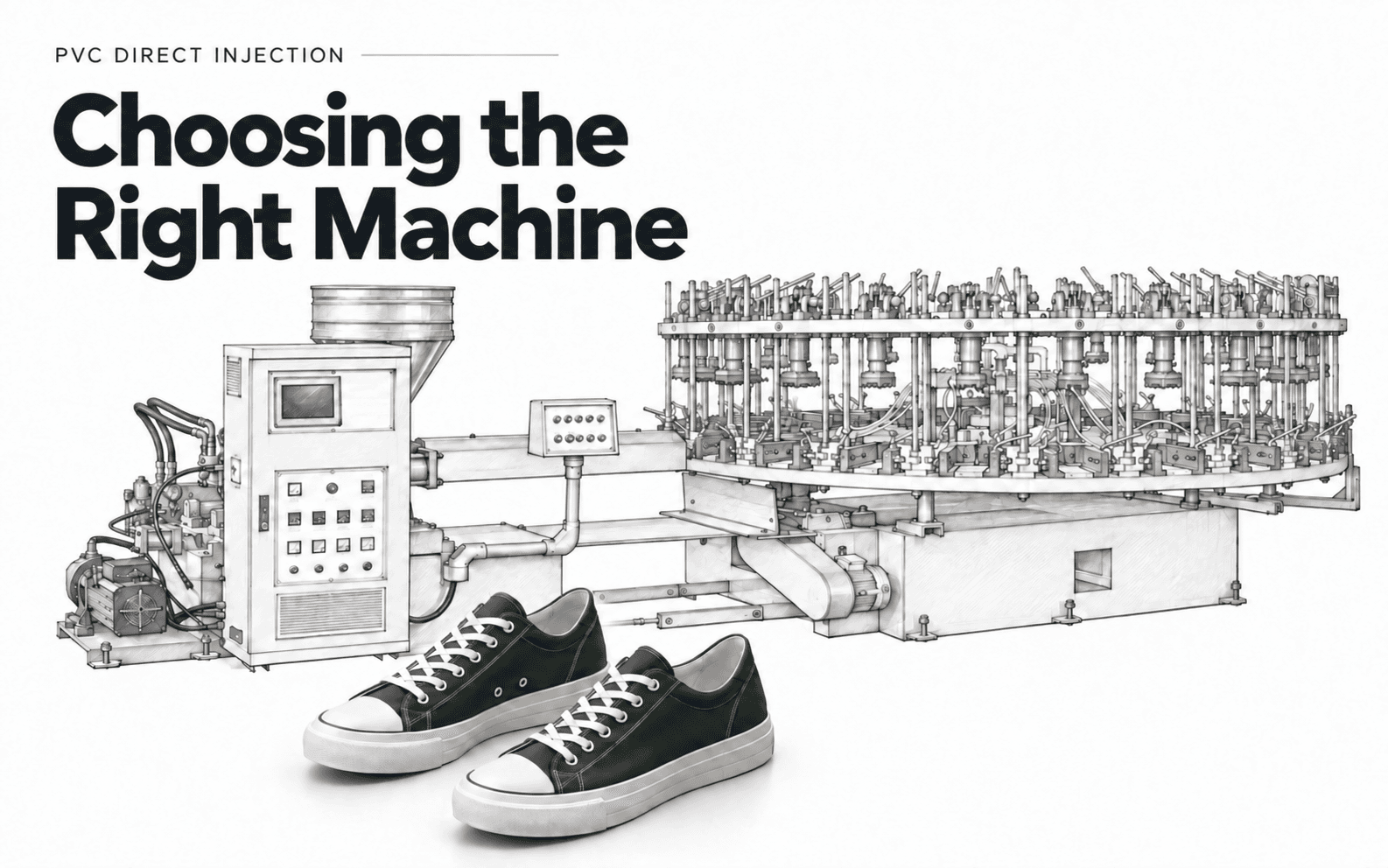
For footwear made by molding a PVC sole directly onto a prepared upper, choose a PVC direct-on-upper injection molding machine. For continuous batch production, evaluate a rotary multi-station configuration, then match its tooling, injection capacity, cooling, and operating cycle to your shoe design and output target.
This process is commonly called the direct injection process, or DIP. Before requesting quotations, define four things: the shoe style, sole construction, PVC compound, and planned production volume. These determine whether a machine is suitable more reliably than its station count or advertised hourly output alone.
Identify the production process first
In PVC direct-on-upper production, the prepared upper is fitted onto a last and positioned in a compatible mold. PVC is injected to form the sole against the upper, followed by cooling, mold opening, and removal. Upper preparation and material compatibility must be validated for the intended shoe.
The phrase “PVC shoe machine” covers several applications. Use the following distinctions when approaching suppliers.
| Target product | Production route | Equipment focus |
|---|---|---|
| Shoes with prepared uppers | Inject the sole onto the upper | PVC direct-on-upper machine |
| Separate outsoles | Mold soles before assembly | PVC outsole machine |
| All-plastic sandals or slippers | Mold the product or components | Equipment matched to the design |
| PVC rain boots | Mold the boot body and sole | Dedicated boot machinery |
Manufacturer product ranges distinguish these processes. Tien Kang describes machinery for injecting PVC soles onto string-lasted footwear, while Wintech offers dedicated PVC boot equipment. Supply a shoe sample, photographs, or a sole cross-section so the supplier can identify the correct production route. [1][2]
Why consider a rotary multi-station machine
A rotary machine carries multiple molds around a table. Injection, cooling, and loading or unloading occur at different positions as production advances. This arrangement provides time for previously injected products to cool while subsequent operations continue.
The operating cycle must also accommodate fitting uppers, removing shoes, and checking mold positioning. More stations may provide additional cooling time, but they do not automatically increase output if injection, manual handling, or upper preparation is the bottleneck.
Ask suppliers to state the shoe style, compound, mold arrangement, staffing, and cooling conditions behind their output figures. Confirm whether output is measured in individual shoes or pairs.
Six factors that determine the right configuration
Shoe style and upper compatibility
Provide the upper material, construction, size range, and sole design. Review last clearance, mold closing, upper positioning, and access for operators. Include the largest intended size when checking the machine and tooling envelope.
During trials, inspect for upper movement, pinching, material leakage, and inconsistent bonding. A successful sample with one textile or synthetic upper does not prove compatibility with every alternative. If several styles share a machine, include mold changes and last handling in the production plan.
Sole colors and layer construction
Single color, two colors, and two layers describe different requirements. A two-layer sole may use different compounds or incorporate a preformed outsole component; it is not necessarily a two-color product.
Two injection units are one available approach to two-color PVC direct-injection footwear, as illustrated by Tien Kang’s TK-996. This is an example of a process configuration, not a capability shared by every rotary machine. [1]
For a preformed insert followed by another injected layer, review insert positioning, material bonding, mold design, and additional handling time. Ask the supplier to explain the complete molding sequence using your sole cross-section.
PVC compound requirements
Specify foamed or non-foamed PVC, the supply form, and target hardness, density, color, and sole weight. Review the compound supplier’s processing guidance against the proposed feeding, plasticizing, injection, and cooling arrangements.
Equipment that supports both foamed and non-foamed PVC still needs suitable settings and validation for each formulation. Do not assume it can also process PU or EVA. Dedicated PU direct-soling equipment uses a different material-processing system and requires separate evaluation. [3]
Injection capacity and tooling fit
Ask the supplier to establish the required shot for your compound and sole construction, then confirm an appropriate operating range. Finished-sole weight alone is insufficient for selecting injection capacity, and a maximum shot-volume figure is not a production guarantee.
Check mold mounting dimensions, injection interface, clamping requirements, last space, and opening movement together. The equipment must accommodate the tooling and make the intended product consistently, including the largest planned size.
Station count and realistic output
Compare 20- and 24-station options using cooling time, injection and indexing rhythm, operator handling, mold allocation, floor space, and tooling investment. Include changeovers, start-up, and planned downtime when estimating daily output.
Request acceptable pairs per hour during a representative run using your intended compound, upper, size mix, and staffing. Keep peak machine output separate from sustained production and saleable output. Additional stations are useful only when they address the actual constraint in the production cycle.
Controls and maintenance
Review temperature and injection adjustments, machine-status information, fault messages, cooling, lubrication, operating safeguards, and access for maintenance. Ask which spare parts should be stocked and how technical support is provided.
If a servo hydraulic system is offered, compare measured energy use under equivalent conditions. The presence of a servo motor does not establish a particular saving. Confirm whether the measurement includes the chiller and other auxiliaries.
Budget for a working production line
The machine quotation is only part of the investment. Include molds and lasts for the planned styles and sizes, upper preparation, utilities, material handling, commissioning, training, and initial spare parts.
Confirm electrical supply, cooling arrangements, and compressed air where required by the selected configuration. Allow room for operators, maintenance, material storage, and finished-shoe movement. Check that prepared uppers can reach the machine at the required rate.
Compare quotations with the same scope. Ask suppliers to identify included equipment, excluded site work, installation responsibilities, and the support available after commissioning.
Validate the proposed machine through trials
Use the upper, sole design, and PVC compound intended for production wherever possible. A demonstration with the supplier’s standard sample shows machine operation; a trial with your materials tests product compatibility.
Agree on three groups of checks before testing.
- Product quality: inspect filling, appearance, dimensions, flash, deformation, and upper-to-sole bonding. Select additional tests, such as flexing or abrasion, according to the footwear’s intended use and customer requirements.
- Production performance: record the operating cycle, staffing, stoppages, rejects, and acceptable output over an agreed continuous run. Include representative sizes where they affect performance.
- Operating cost: measure material consumption and electricity within a defined boundary. Installed power informs electrical planning; it is not measured hourly energy consumption.
Retain accepted samples, compound details, tooling information, operating conditions, and trial results as references for the technical agreement and delivery acceptance.
A brief Xingzhong equipment example
Xingzhong’s XZ-988 product range includes 20- and 24-station rotary configurations, with product information covering computer control, servo hydraulic equipment, and mold cooling. Its DIP molds and PVC foaming materials can be discussed alongside the machine. Select the final package through shoe-sample review and trials rather than treating catalog specifications as guaranteed production results. [4]
Frequently asked questions
Can a standard PVC outsole machine make direct-on-upper shoes
Only if its equipment and tooling support the prepared upper, last, and required molding operations. Ask the supplier to demonstrate compatibility with your shoe construction; the machine name alone is insufficient.
Should I choose 20 or 24 stations
Choose according to cooling time, operator handling, injection rhythm, space, and mold investment. More stations may provide longer cooling intervals, but output does not necessarily rise in proportion to station count.
Can a single-color machine make a two-layer sole
Some constructions may use a preformed outsole insert followed by another injected layer. Feasibility depends on tooling, insert location, material bonding, and machine suitability. Validate the complete process through trials.
Does foamed PVC require different equipment
Check the machine and compound together. Some equipment supports both foamed and non-foamed PVC, but feeding, plasticizing, injection, and cooling conditions must still match the intended formulation.
What should I send with an inquiry
Provide shoe samples or photographs, the size range, upper material, sole construction, colors, intended compound, daily output target, shift arrangement, and site utilities. Include drawings of existing molds or lasts you hope to reuse.
Discuss your production requirements
Share your shoe sample and output target with Xingzhong to discuss equipment, molds, and material matching. Use the proposed trials to establish whether the configuration meets your quality and production requirements.
References
[1] Tien Kang TK-996 product description
[2] Wintech WLX303 PVC boot equipment
[3] Wintech WINSHOES 201 PU direct soling
[4] Xingzhong product information for the XZ-988 range, DIP molds, and PVC foaming materials. Final supply specifications are subject to the agreed technical proposal.