
Industry News
Auxiliary Equipment Items for a PVC Direct Injection Shoe Production Line
Explore six supporting equipment groups for a PVC direct injection shoe production line, from cooling and material preparation to upper lasting and finishing.
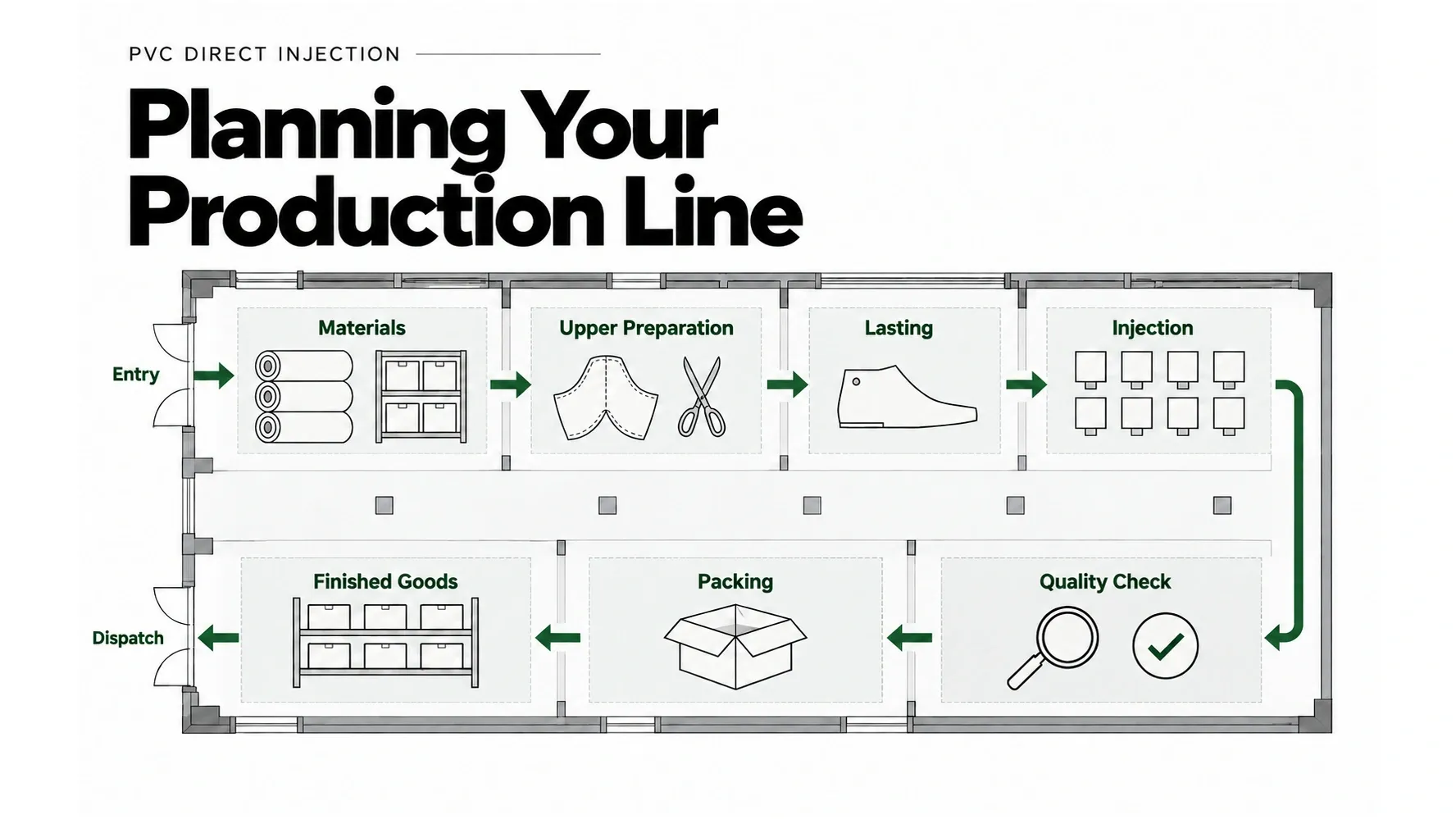
A PVC direct injection shoe production line needs coordinated support around the main machine: a cooling system, a material mixer, a PVC crusher or grinder, an upper heating oven, an upper lasting workbench, and a finishing conveyor line. Together, these six equipment groups support material preparation, upper preparation, machine operation, and the handling of shoes after injection.
In the direct injection process, or DIP, the sole material is injected directly onto the prepared upper. This guide assumes that the factory buys ready compounded PVC granules and completed uppers. It explains what each supporting item does and what buyers should confirm before ordering. The exact configuration should follow the machine requirements, footwear design, material instructions, and intended production schedule. [1]
Equipment at a glance
| Equipment | Main role | Key point to confirm |
|---|---|---|
| Cooling system | Removes heat from specified machine circuits | Water temperature, flow and cooling load |
| Material mixer or color mixer | Blends approved ingredients before injection | Batch size and material compatibility |
| PVC Crusher or Grinder | Crushes PVC injection molding trim and waste for recycling and reuse | Waste size and volume, output particle size, and cleaning access |
| Upper heating oven | Conditions uppers for the specified preparation process | Temperature and exposure time |
| Upper lasting workbench | Supports fitting and checking uppers before injection | Operator access and preparation time |
| Finishing conveyor line | Moves shoes through finishing and packing stages | Workstation sequence and line balance |
1 Cooling system
The cooling system removes heat from the circuits specified by the injection machine manufacturer. Depending on the machine design, these can include hydraulic oil cooling and other process cooling connections. Confirm the actual water circuit arrangement before selecting equipment; different machine designs do not necessarily have the same requirements.
A cooling tower and a chiller provide different cooling capabilities. Conair explains that chillers are used when the required process fluid temperature is lower than a simpler cooling tower system can provide. Select the arrangement around the required water temperature and local operating conditions. Some installations use both within a designed system, but buyers should not assume that every line requires both. [3]
Include the circulation pump, water storage where required, and connecting pipework in the discussion. Ask the supplier to specify cooling capacity, flow, pressure, and water quality requirements. Check whether the quotation covers the complete working circuit and installation connections, rather than only the cooling unit.
2 Material mixer or color mixer
A material mixer prepares a uniform batch of approved feed materials before they enter the injection machine. Its role can include blending PVC granules with compatible color masterbatch or with an approved proportion of recovered material. Equipment suppliers list mixers among the supporting machines for PVC footwear production. [2]
Because this production setup uses purchased PVC compound, the starting material already has a formulation. Confirm with the compound supplier which additions are permitted. A mixer distributes the ingredients; it cannot make an incompatible colorant or an unsuitable material blend perform correctly. Ready colored compound may require little or no additional color blending. [4]
Choose batch capacity around actual material consumption and the frequency of color changes. For example, frequent short orders favor a mixing routine that avoids leaving large quantities of the previous color. Keep batch identification clear, measure additions consistently, and clean the mixing chamber between incompatible colors or materials. Confirm the recommended mixing time through trials.
Before purchase, ask how the mixer is emptied and cleaned, and how operators will identify a completed batch. Confirm that the supplier has considered the handling characteristics of the actual footwear compound. A demonstration using your intended material is more useful than a capacity figure quoted without loading or discharge conditions.
3 PVC Crusher or Grinder
A PVC crusher or grinder breaks down edge trim, sprues, runners, and other suitable PVC waste generated during the injection molding process. It reduces this production scrap into smaller pieces that can be collected and prepared for reuse, helping the factory recover material and reduce waste.
For a PVC direct injection shoe production line, the crusher supports the recycling of scrap produced during shoe sole molding and subsequent trimming. After crushing, suitable recovered material can be blended with fresh PVC compound and returned to production. The blending ratio should follow the material supplier’s guidance and be verified against the finished shoe’s quality requirements.
Keep scrap separated by PVC formulation and color, and remove fabric, metal, and other contaminants before crushing. When selecting a crusher or grinder, consider the size and volume of the waste, the required output particle size, and access for cleaning and blade maintenance.
4 Upper heating oven
An upper heating oven supports upper conditioning or shaping when the footwear preparation process calls for heat. A footwear equipment supplier includes an oven and workbench for upper processing, shaping, and fitting the upper onto the last. This is an upper preparation operation, distinct from drying PVC feed material. [2]
The correct treatment depends on the upper construction. Fabric, synthetic coverings, linings, and reinforcements may respond differently, so a universal oven temperature is inappropriate. Confirm the heating purpose, temperature, and exposure time with the upper supplier and through sample trials. Inspect treated uppers for dimensional change, surface marking, and any loss of the intended shape.
Size the oven around the preparation sequence and the number of uppers that must be ready for injection. Discuss loading access and temperature uniformity with the supplier. Include waiting time after heating in the trial procedure, so operators can reproduce the approved preparation conditions during normal production.
5 Upper lasting workbench and tools
The upper lasting workbench provides a dedicated station for fitting the prepared upper onto the last and checking its position before injection. Operators use the appropriate hand tools to adjust the upper and smooth wrinkles. The aim is to present the upper consistently to the injection operation. [2]
Plan the bench around the footwear being produced and the movements operators need to make. Provide a clear working surface, comfortable access, and space to separate incoming uppers from those ready for injection. A simple visual reference showing the accepted upper position can help operators recognize preparation differences before the next stage.
Measure the preparation time using representative styles and sizes. If fitting and checking take longer than expected, the main machine may wait for prepared uppers. Use those observations to determine the working space and staffing arrangement. Include checks for wrinkles, alignment, and visible damage in the preparation routine, rather than relying entirely on inspection after injection.
6 Finishing conveyor line
The finishing conveyor line organizes the movement of shoes after injection through trimming, appearance inspection, pairing, and packing preparation. Footwear finishing guidance identifies trimming, final inspection, and packing as distinct operations. The conveyor connects these tasks; operators still carry out the work assigned to each station. [6]
Set the workstation order around the shoe design and required finish. A practical arrangement can move shoes from receipt to removal of excess material, visual checking, pairing by size and color, and packing. Provide a separate route for shoes requiring correction so they are not accidentally mixed with accepted pairs.
Specify conveyor length and speed from observed task times and available floor space. Allow sufficient working room at slower stations, and confirm that the handling method avoids marking the shoes. During a trial run, watch for queues before inspection or packing. Adjust the work distribution to keep output moving without rushing checks or allowing shoes to accumulate around the injection machine.
Give each station a clear acceptance reference and a defined place for completed work. Keep size and color identification with the shoes until pairing is complete. These simple arrangements help a finishing line remain understandable when styles change or different operators take over a station during the production day.
Frequently asked questions
Does every line need the same cooling equipment
No. Cooling equipment must match the specific machine circuits and required water conditions. Confirm the cooling load and site conditions before choosing a tower, a chiller, or a combined arrangement.
Can all PVC production scrap be reused
No. Only suitable, controlled scrap should enter the approved recovery stream. The acceptable proportion depends on the compound and finished product requirements. Validate reuse through production trials rather than assuming a universal percentage.
Does a finishing conveyor make the process fully automatic
No. A conveyor transports shoes between stations. Trimming, inspection, pairing, and packing still require the assigned operations and personnel. Its layout should give each task enough time and working space.
Discuss your production line requirements
To discuss a PVC direct injection shoe production line with Xingzhong, share your shoe samples, upper construction, PVC compound information, target output, and factory layout. Ask for a coordinated proposal covering these six supporting equipment groups and their connections to the main machine. Use sample trials to confirm preparation methods, material handling, and finishing flow before finalizing the configuration.