
Company News
Mold Cooling for PVC Direct Injection Shoes: Better Sole Quality and Higher Output
Xingzhong’s mold cooling system uses chiller-connected aluminum plates to improve PVC sole shape retention and shorten cooling time. Reported output gains average approximately 20%, depending on sole design and production conditions.
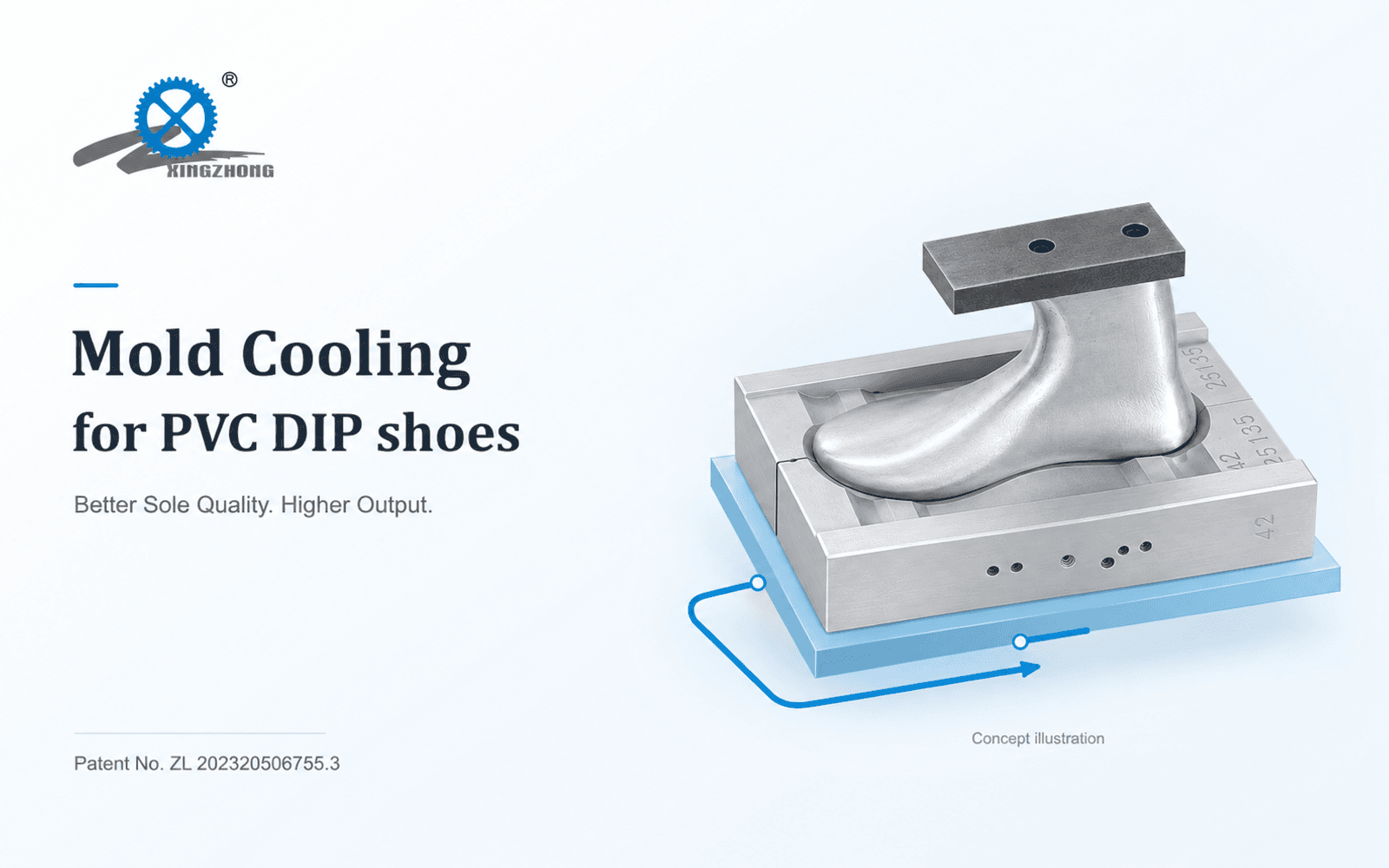
Mold cooling for PVC shoe injection molding helps remove heat from the mold so the sole can reach a suitable condition for demolding. Xingzhong uses aluminum cooling plates connected to a water chiller to lower mold temperature. In the company's practical applications, this system has improved sole shape retention, reduced bulges associated with delayed cooling, and shortened cooling and setting time.
Xingzhong reports an average production output increase of approximately 20% in practical applications, with results varying according to sole thickness, size, and production conditions. Understanding how cooling affects both quality and production timing helps manufacturers assess this technology for their own footwear.
Why Mold Cooling Matters in PVC Shoe Production
In direct injection footwear production, the PVC sole is formed onto the shoe upper. After injection, the material must cool sufficiently to retain its intended shape when the mold opens and the shoe is removed.
Repeated injection introduces heat into the mold. When heat removal cannot keep pace with production, cooling can become a constraint: operators may need to allow more time before demolding to achieve acceptable sole quality.
Autodesk's documentation on time to reach ejection temperature explains that hot spots and thicker sections can take longer to cool. These general injection molding principles help explain why mold temperature management deserves attention in shoe production.
For a PVC direct injection shoe machine, the practical objective is to reach an acceptable demolding condition efficiently while preserving the required sole shape.
How Xingzhong's Mold Cooling System Works
Xingzhong's system combines an aluminum cooling plate with a connected water chiller. The plate provides a path for heat to move away from the mold, while the cooling circuit carries that heat to the chiller.
The heat-transfer sequence is:
- Heat passes from the molded sole into the mold.
- The aluminum cooling plate receives heat from the mold.
- Circulating coolant carries heat away from the plate.
- The chiller removes heat from the returning coolant for continued cooling.
This arrangement supports heat removal during production. Its effectiveness depends on the thermal contact, cooling capacity, and operating conditions of the installed system.
According to Xingzhong, it was the first manufacturer in China to apply a mold cooling system to PVC direct injection shoe machines. The company's About page lists Chinese utility model patent ZL 202320506755.3, described in English as "Injection Molding Machine with a Cooling Mechanism." This patent relates to the mold cooling solution discussed here.
Better Sole Shape Retention and Fewer Cooling-Related Bulges
A sole that has not cooled sufficiently can be vulnerable to deformation during demolding and subsequent handling. Xingzhong reports that its mold cooling system improves sole setting and reduces the bulging it has observed when cooling is delayed or inadequate.
The broader technical background involves temperature distribution and shrinkage. Autodesk's guidance on differential cooling and warpage explains that temperature differences across a molded component can produce unequal shrinkage and bending.
This supports the importance of cooling control, but it does not establish that every sole bulge has the same cause. Material, mold geometry, filling, and other process conditions should also be considered when investigating a defect.
For Xingzhong's application, the reported benefit is specific: better cooling helps the sole retain its intended shape and reduces bulges associated with insufficient cooling.
Approximately 20% Higher Output in Practical Applications
According to Xingzhong's practical application experience, the mold cooling system increases production output by approximately 20% on average. The actual improvement varies with sole thickness, dimensions, and production conditions.
The production logic is straightforward: when cooling is the limiting step, removing heat more effectively can reduce the time needed before demolding. A shorter cooling requirement can then allow the machine to sustain a faster production rhythm.
On a machine with multiple working stations, some operations overlap. Reducing sole cooling time improves overall output only to the extent that the remaining machine operations and operator workflow can support the faster pace.
An output increase is also different from a cooling-time reduction. Approximately 20% higher output does not mean that cooling time falls by 20%. Output reflects the complete production process, including overlapping operations and downtime.
A useful factory evaluation compares the same shoe design, material, quality criteria, and measurement period before and after the change. Recording acceptable output, cooling settings, and stoppages helps determine the benefit for that particular application.
Why Results Vary Between Shoe Designs
Sole Thickness and Dimensions
Different soles contain different amounts and distributions of material. A thick heel or locally heavy section may remain warm longer than a thinner area. Autodesk's wall-thickness guidance identifies thick sections as a cause of longer cooling times and potential molding defects.
Sole size therefore needs to be considered together with local thickness and geometry when assessing cooling requirements.
Material and Process Conditions
PVC formulations and processing conditions differ between footwear applications. Cooling settings should suit the material, mold, and required demolding condition. A setting that works for one sole should be checked before applying it to another design.
Other Production Bottlenecks
Faster cooling cannot automatically shorten every operation. Injection, station movement, upper loading, shoe removal, and handling can still determine the achievable production rate.
The strongest opportunity is an application where cooling currently restricts the production rhythm and the other operations have room to run faster.
Frequently Asked Questions
How does an aluminum cooling plate cool the mold?
The plate transfers heat away from the mold to a cooling circuit connected to a water chiller. The chiller removes that heat from the coolant, allowing the circulation process to continue.
Will every shoe design achieve a 20% output increase?
No. Xingzhong reports approximately 20% higher output on average in practical applications, with results varying by sole thickness, size, and operating conditions. The improvement for a specific shoe should be assessed against its existing production process.
Is a lower cooling temperature always better?
No. Cooling should be matched to the material and molding process. The aim is reliable sole formation and an appropriate demolding condition. Temperature distribution and overall process stability also matter, so the lowest available chiller setting should not be treated as the target.
What is the patent number for Xingzhong's mold cooling system?
The patent number is ZL 202320506755.3. Xingzhong lists it as a Chinese utility model patent, with the English description "Injection Molding Machine with a Cooling Mechanism." The certificate is displayed in the Patents & Innovation section of Xingzhong's About page.
Discuss Your Production Requirements with Xingzhong
If sole cooling limits your current production, share your sole dimensions, thickness profile, PVC material requirements, and target output with Xingzhong. These details provide a starting point for reviewing a suitable machine and cooling configuration.
Explore Xingzhong's shoe production equipment and materials, or contact Xingzhong to discuss your PVC shoe production requirements.