
Industry News
PVC Direct Injection vs Cemented Footwear: Cost and Production Efficiency
Compare PVC direct injection and cemented footwear across tooling, labor, production output, and order size, with a practical framework for calculating cost per acceptable pair.
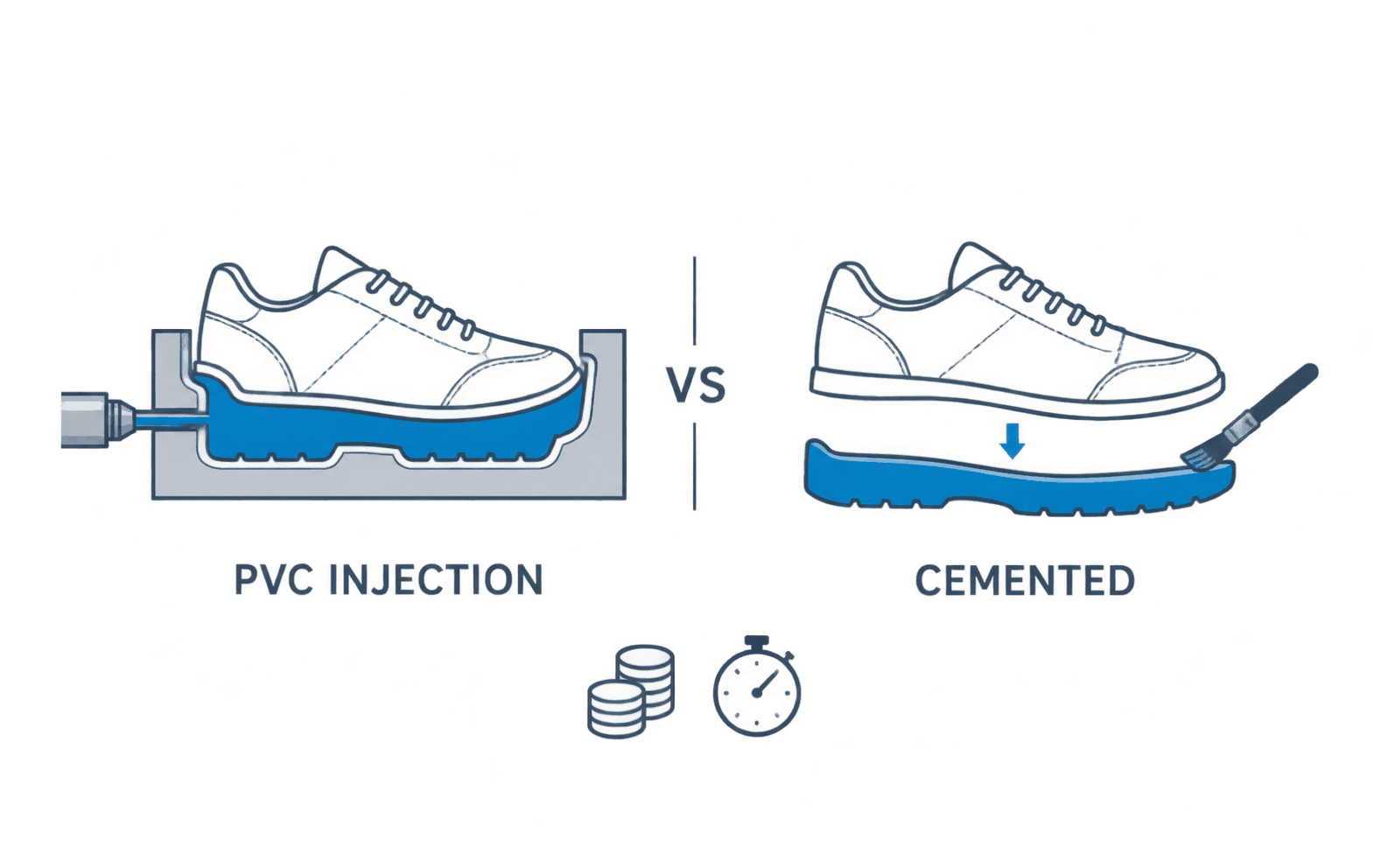
PVC direct injection can reduce sole-attachment operations by forming the outsole directly onto the upper. Cemented construction attaches a separately manufactured sole with adhesives, offering flexibility when established sole designs and suppliers are available. Neither process is automatically cheaper or faster: tooling, order volume, equipment utilization, labor, and quality performance determine the result.
For manufacturers comparing PVC direct injection vs cemented shoes, the useful measures are cost per acceptable pair and time to complete an order. Raw material prices or advertised machine output alone cannot establish which process is more economical.
This guide separates the process differences from the commercial assumptions that require factory-specific data.
What Is the Difference Between PVC Direct Injection and Cemented Construction?
PVC direct injection footwear
In PVC direct injection, prepared uppers are positioned on suitable lasts in the molding system. Plasticized PVC enters the mold cavity, forming the sole and joining it to the upper. After sufficient cooling, the footwear is removed for finishing and inspection.
The principal benefit is combining operations. SATRA explains that direct molding forms and attaches the sole together, while making the footwear manufacturer responsible for sole molding instead of buying finished soles. Source: SATRA, Direct moulded soles in footwear production
Cold cement shoe manufacturing
Cemented footwear uses a separately manufactured sole unit. Depending on the materials and adhesive system, assembly includes surface preparation, adhesive application, drying, activation, sole positioning, and pressing.
“Cold cement” does not mean that every operation occurs without heat. SATRA identifies adhesive drying, activation, and pressing among the stages requiring process control. Source: SATRA, Sole Bond Award
PVC is a material, while cementing is an attachment method. A comparison involving different sole materials therefore combines material and process differences. Establish equivalent product requirements before comparing costs.
PVC Direct Injection vs Cemented Shoes: Quick Comparison
| Factor | PVC direct injection | Cemented construction |
|---|---|---|
| Sole formation | Sole forms directly onto the upper | Sole is manufactured separately |
| Investment focus | Injection equipment, molds, and supporting systems | Preparation, adhesive application, drying, and pressing equipment |
| Labor focus | Upper loading, machine operation, unloading, and finishing | Preparation, adhesive handling, alignment, and assembly |
| Output constraints | Injection, cooling, loading, and equipment availability | Line balance, adhesive processing, and assembly capacity |
| Changeover factors | Molds, colors, materials, and setup | Sole availability, fixtures, materials, and bonding adjustments |
| Potential fit | Repeat production that supports tooling utilization | Varied orders using available sole units and suppliers |
These are evaluation criteria, not guaranteed advantages. Factory organization and automation can change the outcome.
Which Process Has a Lower Manufacturing Cost?
Equipment and molds
PVC direct injection requires appropriate molding equipment, product-specific tooling, and supporting facilities. The financial question is how much acceptable production will absorb that investment.
A mold used for repeated orders may contribute relatively little to each pair. Tooling developed for a short-lived style can have a much higher allocation per pair, particularly when several sizes are required.
Cemented factories also need equipment. Purchasing existing sole units may avoid an in-house sole-molding investment, but custom soles still require development and tooling somewhere in the supply chain. Those charges may be separate or embedded in the supplier’s quotation.
Compare complete production arrangements. Using an existing line is a different decision from building a new facility.
Materials and consumables
Direct-injection costing should include PVC compound, sole weight, process losses, and required preparation or finishing consumables. Cemented costing should include purchased soles, adhesives, treatment agents, and associated losses.
The price of PVC compound is not directly comparable with the price of a finished outsole. The purchased outsole includes the supplier’s conversion costs, overhead, and margin. Direct injection transfers the molding operation into the footwear factory rather than eliminating its cost.
Use equivalent design and performance requirements, and include every operation needed to produce acceptable footwear.
Labor and automation
Direct injection can reduce work associated with separate sole attachment. WINTECH describes automation and low labor requirements as features of its PVC and thermoplastic direct-on-upper equipment. This supports the potential for savings, not a universal staffing or productivity ratio. Source: WINTECH, Direct injection on upper machine
Cemented production is also evolving. Henkel describes adhesive systems suitable for manual application or automatic spraying, alongside process simplification that can reduce manufacturing steps. Source: Henkel, Process simplification and sustainability
Measure total labor hours across preparation, handling, assembly, inspection, and rework. Comparing one injection operator with an entire cementing line would give a misleading result.
Energy and quality losses
Direct injection consumes energy for material processing, machine operation, and cooling. Cemented production may require drying, activation, pressing, and extraction systems. Measure energy per acceptable pair before claiming an advantage.
Quality losses also affect footwear manufacturing cost. A rejected shoe can waste its upper, sole materials, and processing time. Include actual scrap and rework costs rather than assuming that fewer operations automatically produce lower total expenditure.
Which Process Offers Better Shoe Production Efficiency?
Direct injection combines sole formation and attachment, but factory output depends on the slowest relevant production stage.
An injection machine cannot deliver its planned output if prepared uppers arrive late or finishing capacity is insufficient. Loading, cooling, downtime, and changeovers also influence actual production.
Cemented lines require compatible capacities across preparation, adhesive processing, positioning, and pressing. Several pairs can pass through different stages simultaneously. Adding the processing time of every operation therefore does not reveal hourly line output.
For a useful comparison, track three measures:
- Acceptable pairs per hour: production output after quality losses.
- Acceptable pairs per labor hour: labor productivity across the defined process.
- Order completion time: calendar time including setup, waiting, production, and inspection.
Keep the measurement boundary consistent. If one factory purchases finished soles while another molds them internally, account for outsourced cost and lead time without treating them as in-house labor.
How Order Size and Changeovers Affect the Result
Stable styles and repeat orders allow setup and tooling costs to be spread across more pairs. This makes direct injection worth evaluating when the product is technically suitable and equipment can remain productively occupied.
For small batches using readily available sole units, cemented construction may reduce development work. That advantage depends on supplier minimum quantities, stock availability, and compatibility with the upper.
Record the cost of changing products. Injection changeovers can involve molds, colors, materials, and trial production. Cemented changeovers may involve sole deliveries, fixtures, surface preparation, or adhesive adjustments.
A large order does not automatically favor injection, and a small order does not automatically rule it out. Existing molds, available capacity, and supplier readiness can change the economics. These are conditional business scenarios, not fixed industry rules.
How to Calculate Cost per Acceptable Pair
Use a consistent accounting period and production boundary:
Cost per acceptable pair = Total attributable manufacturing cost ÷ Accepted pairs produced
Include materials, labor, energy, allocated tooling and equipment costs, maintenance, consumables, and relevant overhead. Count quality losses once: do not add a second scrap allowance when the recorded material and labor consumption already includes rejected production.
Your comparison sheet should record order quantity, repeat demand, size distribution, sole weight, setup time, staffing, production hours, energy use, and accepted output.
Where additional fixed investment and variable-cost savings are both known, estimate break-even volume:
Break-even pairs = Additional fixed investment ÷ Variable-cost saving per acceptable pair
This simplified calculation applies only when the saving is positive and assumptions remain consistent. It does not replace a cash-flow assessment covering financing, capacity constraints, maintenance, and changing product demand.
Frequently Asked Questions
Is PVC direct injection always cheaper than cemented footwear?
No. Direct injection can reduce separate attachment operations, but tooling, equipment utilization, material consumption, labor, and quality losses determine the cost per acceptable pair.
How many pairs justify direct-injection tooling?
There is no universal minimum. Calculate the threshold using the tooling quotation, expected repeat volume, available equipment, and measured variable-cost differences.
Are cemented shoes necessarily slower to manufacture?
No. A balanced cemented line processes multiple pairs concurrently. Compare accepted output and order lead time rather than the duration of one adhesive-processing stage.
Does direct injection eliminate bonding-quality risks?
No. Validate attachment performance for the chosen upper, sole compound, and product requirements. Removing separate cementing does not remove the need for quality control.
Choosing the Right Process for Your Order
First confirm that the construction meets the footwear’s design and performance requirements. Then compare actual quotations and representative trials using the same order quantity, acceptance criteria, and cost boundary.
For repeat production, assess how effectively injection combines operations and absorbs tooling costs. For varied orders, examine the value of existing sole units and cementing capacity.
To discuss equipment suitability, contact Xingzhong with your shoe design and production requirements. Include upper materials, size range, expected order volume, and target output so that the assessment can address the intended product and operating conditions.