
Industry News
Poor Sole-to-Upper Bonding in PVC Direct Injection Footwear: A Troubleshooting Guide
A practical guide to tracing weak PVC sole-to-upper bonds through failure surfaces, material comparisons, process checks, and controlled testing.
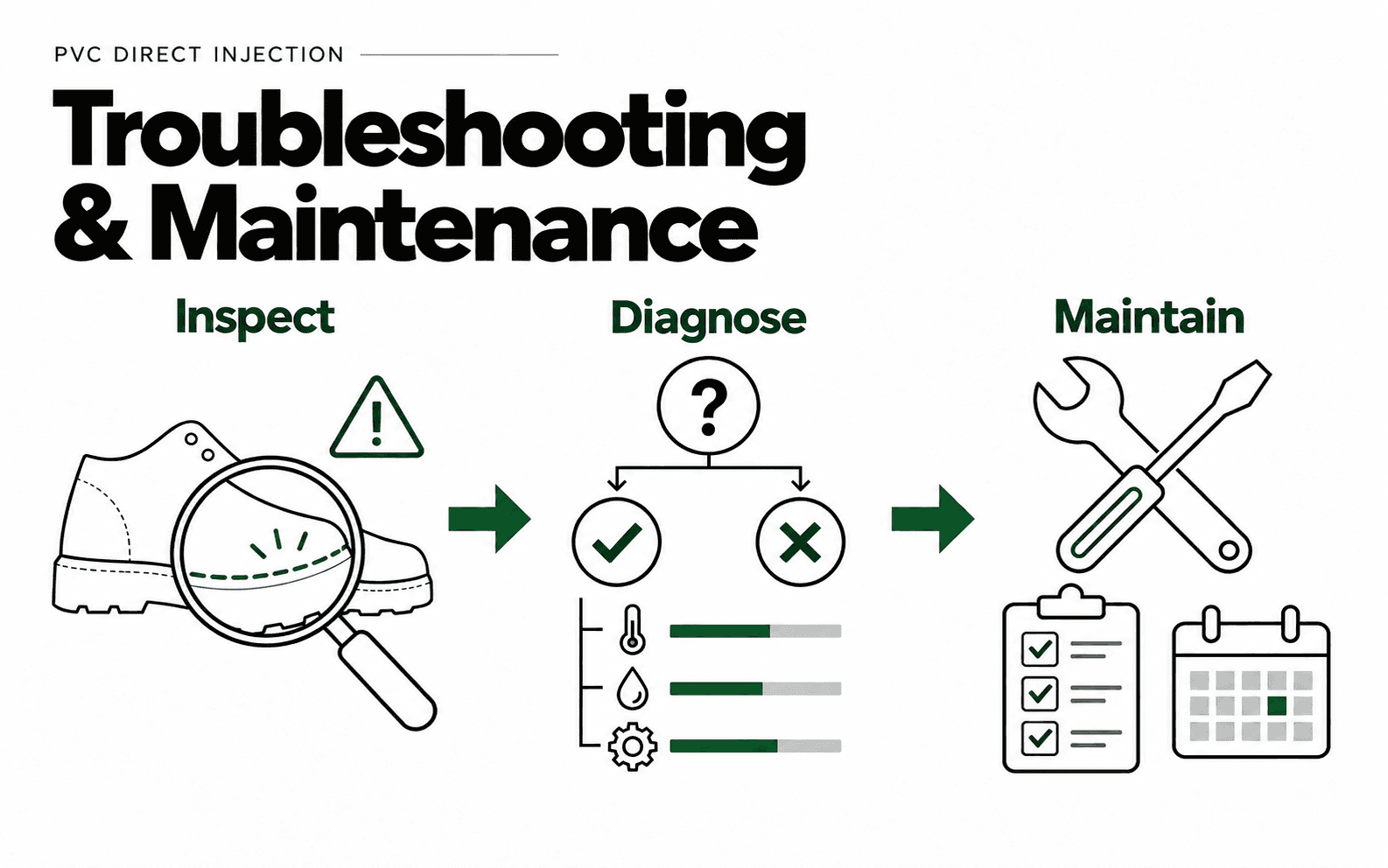
To troubleshoot PVC direct injection sole bonding problems, identify where separation occurs, map the defect by position and production batch, then check upper preparation, material compatibility, molding conditions, and tooling. Confirm the cause through controlled comparisons and appropriate bond tests before releasing corrected production. Increasing temperature alone is not a reliable solution.
Direct injection forms the PVC sole against a prepared upper. A weak connection may involve the interface, a coating within the upper, or the sole material itself. These failures can look similar from outside but require different corrective actions.
This guide provides an investigation sequence for footwear production managers and technicians. The checks below identify possible causes; they do not diagnose a particular shoe without production evidence.
1. Identify the Failure Surface Before Changing Settings
Retain defective shoes and a comparable acceptable sample. Mark the separation location and photograph both exposed surfaces before cleaning, repairing, or pulling them further apart. Additional tearing can obscure the original failure.
| Observation | Priority investigation |
|---|---|
| Relatively clean separation between upper and PVC | Contamination, surface suitability, preparation, and contact conditions |
| Upper coating or film remains attached to the sole | Adhesion between the coating and its backing |
| Fabric or upper substrate tears | Substrate strength, preparation damage, and local loading |
| PVC remains on the upper while the sole tears internally | Sole strength, plasticization, and void or foam structure |
| Several patterns appear together | Record each region separately and investigate mixed failure |
These observations indicate where to investigate, not whether a product passes. Substrate tearing can occur at an unacceptably low force. SATRA notes that inadequate upper-finish adhesion can cause peeling during manufacture or wear. SATRA: Adhesion of finish tester
2. Map Where and When the Problem Appears
Record toe, waist, heel, and sidewall locations separately. Identify whether separation appears during demolding, after cooling, after storage, or during flexing.
Compare station numbers, molds, sizes, operators, material batches, and production times. A defect confined to one station suggests investigating its tooling and operating conditions first. A problem across stations after an upper change suggests investigating the new material or preparation first. Neither pattern proves the cause.
Check the last known acceptable production and document what changed afterward. Preserve settings and traceability before trials. Keep suspect production identifiable and subject to the factory’s quality-release procedure.
3. Check the Upper and Its Prepared Bonding Area
Establish what the PVC actually contacts: exposed textile, leather, a coated surface, backing, or another layer. Similar-looking uppers may have different finishes or constructions.
Inspect for dust, oil, handling contamination, and residues from earlier operations. Check whether the upper’s coating is secure before treating the issue as a PVC interface problem.
Where roughing is specified, examine coverage, consistency, and damage. Excessive treatment may weaken fibers or stitches; insufficient treatment may leave an unsuitable surface. DESMA describes material-dependent control of roughing pressure and processing speed, supporting a tailored approach rather than one setting for every upper. DESMA: Roughing and direct-soling automation
Where a primer or auxiliary adhesive is part of the validated construction, verify product identity, preparation, application, drying, and permitted waiting time. Follow supplier instructions for moisture conditioning or cleaning; do not introduce an arbitrary solvent or drying temperature.
4. Compare PVC Batches and Material Combinations
Confirm whether the actual upper and PVC compound have previously passed production trials together. Compare batch records, hardness specifications, color additions, regrind use, and storage history. Investigate unexpected contamination or changes in mixing practice.
For foamed soles, examine whether failure runs through abnormal voids or weak material near the interface. Delayed failure may justify investigation of aging, migration, or changes within the upper, but timing alone cannot establish any of these mechanisms.
Use a controlled material comparison:
| Trial | Upper | PVC | Purpose |
|---|---|---|---|
| Baseline | Previously validated | Previously validated | Confirm the process still produces the reference result |
| Upper comparison | Suspect | Previously validated | Investigate the upper change |
| Compound comparison | Previously validated | Suspect | Investigate the PVC change |
| Combined comparison | Suspect | Suspect | Observe possible interaction between changes |
Keep preparation, tooling, and settings consistent where technically appropriate. Use repeated specimens, record trial order, and assess carryover when changing compounds. If the baseline fails, resolve that instability before attributing the problem to new materials.
SATRA TM402B describes preparing thermoplastic injected-on assemblies for subsequent bond evaluation, including material combinations with or without auxiliary adhesives. It is a specimen-preparation method, not a universal acceptance threshold. SATRA TM402B
5. Verify Actual Molding, Cooling, and Demolding Conditions
Plasticization and temperature
Compare actual operating behavior with the approved process. Check heaters, temperature measurement, feed consistency, and differences between startup, steady production, and restart. A controller setting does not establish the material’s actual thermal condition.
Use the selected flexible PVC compound’s processing guidance. Do not transfer settings from rigid PVC, PU, or another material. Suspected overheating or degradation requires the plant’s established response, rather than further temperature increases.
Filling and contact
Compare incomplete areas and failure locations with the filling pattern. Investigate shot consistency, injection speed and pressure, and machine repeatability. Check holding settings where relevant to the equipment and process.
A larger shot or higher pressure will not correct an incompatible surface and may introduce other defects. Changes should address an observed problem within the validated operating range.
Cooling and removal
Watch demolding for stretching, localized pulling, or distortion. Determine whether the connection was already weak or was damaged during removal. Compare cooling conditions and actual cycle timing between affected and acceptable stations.
6. Inspect Molds, Lasts, and Upper Positioning
Check that the upper fits the last correctly without folds, movement, or misalignment. Compare the actual contact band and sole coverage with the intended design.
Inspect mold-to-last matching, locating components, closure, and any region that pinches or shields the upper. Review gates, flow paths, and vents in relation to the defect location. Where release agent is used, check for unintended contact with the bonding area.
A recurring defect at one location warrants a focused inspection, not immediate tooling modification. Confirm the suspected mechanism before altering a mold. Perform equipment inspection under the applicable isolation and maintenance procedure.
7. Verify the Correction with Consistent Testing
Change one principal factor at a time and retain a baseline. When interacting factors require a broader experiment, define the combinations and evaluation criteria beforehand.
Keep specimen preparation, conditioning, test timing, and test method consistent. Record individual locations and failure modes alongside measured strength; an average can hide a weak region.
SATRA TM411 evaluates sole bonds in completed footwear at relevant positions around the upper margin, with applicability depending on construction. Its public description covers suitable molded-on and stuck-on soles. Obtain the full applicable method for testing instructions and use the product specification to establish acceptance criteria. SATRA TM411
Add flexing, aging, or other evaluations required by the product and failure history. Verify affected sizes and stations during a representative production run. Document the accepted process and monitoring checks; one improved sample is insufficient evidence of a stable correction.
Frequently Asked Questions
Will increasing injection temperature solve weak bonding?
Only if evidence identifies an inadequate thermal condition and the adjustment remains suitable for the compound and upper. Temperature cannot repair a weak coating or remove contamination.
Does PVC direct injection always eliminate primers or adhesives?
No. Requirements depend on the material combination and validated construction. Confirm compatibility through trials rather than assuming either that auxiliary treatment is always required or never needed.
Why does separation occur only at the toe or one station?
Investigate local positioning, contact geometry, filling, cooling, and tooling condition. Compare acceptable locations and stations before concluding that the machine or material is responsible.
Does a torn upper mean the bond is acceptable?
No. Record the failure mode and measured result. Acceptance depends on the applicable requirements, including how material failure is evaluated.
What should be checked when separation appears after storage or flexing?
Compare retained samples under consistent conditions, identify the failed layer again, and review material changes and exposure history. Select relevant aging or flexing evaluations rather than assuming the initial bond result explains later behavior.
Prepare an Evidence Package for Your Supplier
Before requesting equipment or material support, assemble:
- Photographs of both failure surfaces, marked locations, and comparable acceptable shoes.
- Upper construction, PVC identification, batch numbers, and preparation details.
- Machine, mold, last, station, and size identifiers.
- Approved settings, actual observations, cycle timing, and recent changes.
- Failure frequency, trial history, conditioning details, and test results.
These records help separate material, preparation, and processing questions. They also make corrective trials reproducible, so production decisions rest on demonstrated improvement rather than a temporary reduction in visible separation.