
Industry News
PVC Direct Injection: Encoder Metering vs. Mold Microswitch Control
How encoder-controlled preplasticizing helps PVC footwear factories improve shot repeatability, simplify setup, and reduce mold-side maintenance—and what it cannot measure.
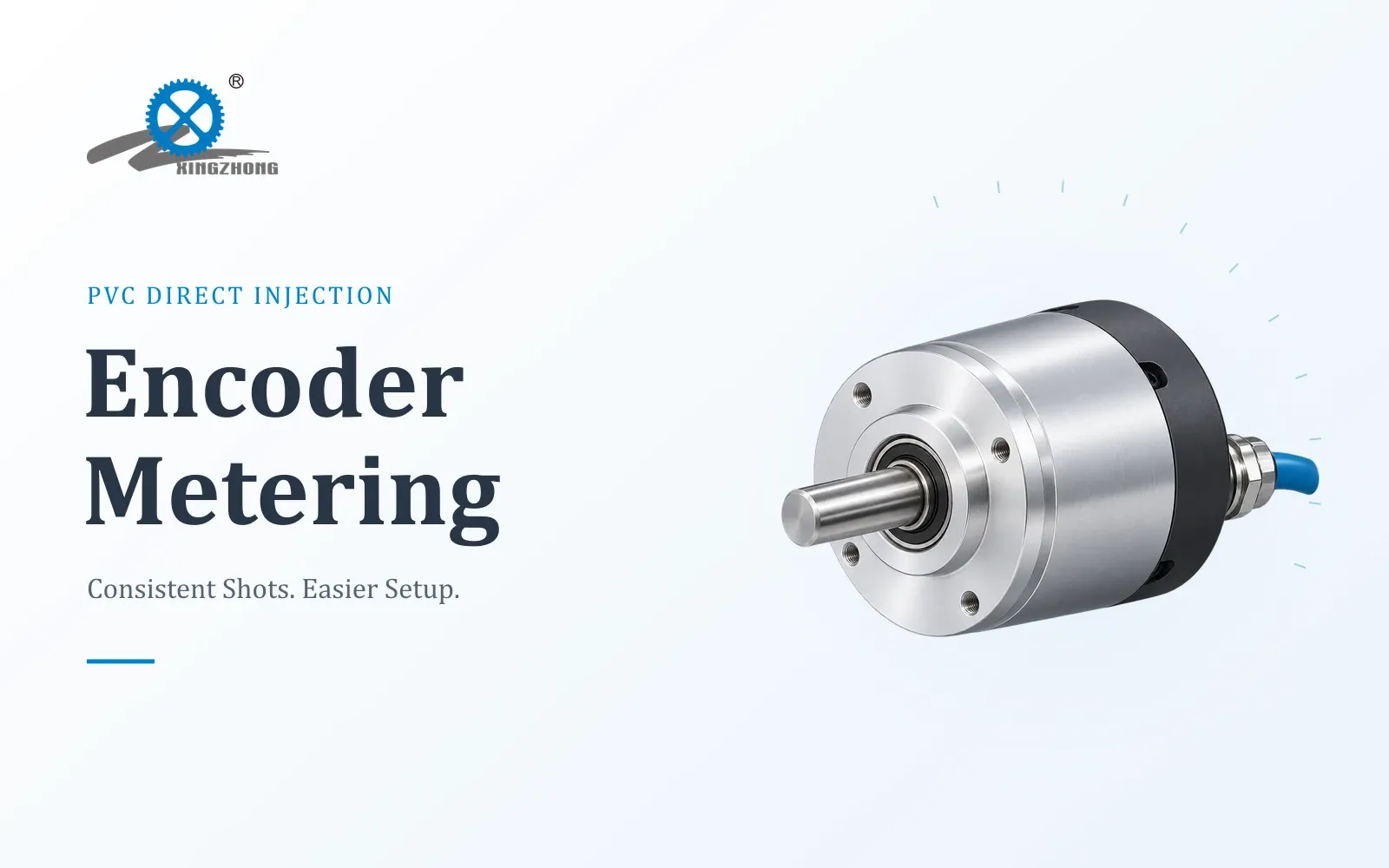
Encoder-controlled preplasticizing can improve shot repeatability, simplify material adjustments, and reduce mold-side maintenance in PVC direct injection. Compared with a mold-mounted microswitch that triggers a stop through mechanical movement, it gives operators a numerical metering setting they can adjust and reuse. Actual results still depend on the machine design, material, and molding conditions.
For footwear factories, the practical benefits are more consistent sole weight, easier size changes, and less repeated setup work.
Why Material Quantity Matters in PVC Direct Injection
PVC direct injection molds the sole directly onto a prepared shoe upper. Each shot must supply enough material to fill the intended cavity under the selected injection conditions.
Insufficient material can leave incomplete soles. Excess material can contribute to flash and additional trimming. Unstable shot quantity also makes it harder to maintain consistent sole weight across production.
On a rotary machine producing several shoe sizes, each mold may need a different quantity. A useful control system must therefore make those settings both repeatable and easy to manage.
How Do the Two Control Methods Work?
Mold-mounted microswitch control
In the older arrangement considered here, filling causes a pin or another mechanical element to move and actuate a microswitch. The resulting signal tells the machine to stop material delivery.
Repeatability depends partly on the trigger position, mechanical movement, switch condition, and the delay between the signal and actual flow stopping.
This comparison applies specifically to that arrangement. On some machines, a mold-mounted switch identifies a mold or selects a preset quantity instead; its role must be checked before comparing systems.
Encoder-controlled preplasticizing
Preplasticizing prepares molten material for the next injection. An encoder supplies motion feedback to the controller, which stops metering when the programmed target is reached.
What the encoder measures matters. A rotary encoder may count screw revolutions or, through a mechanical transmission, indicate metering travel. These are different ways of estimating material quantity and require different calibration.
Screw-turn metering has an established technical basis: patent CN100540265C describes a sole injection machine that measures screw revolutions using an optoelectronic arrangement. It supports the metering principle, rather than proving the performance of every modern encoder system.
Encoder Metering vs. Microswitch Control at a Glance
| Factor | Mold-actuated microswitch | Encoder-controlled preplasticizing |
|---|---|---|
| Control reference | A mechanical trigger event | A programmed motion target |
| Quantity adjustment | Often requires mechanical adjustment | Numerical adjustment through the controller |
| Repeatability influences | Trigger position, wear, friction, stop delay | Sensor resolution, drive response, calibration, material behavior |
| Setup reuse | May require restoring mechanical positions | Saved settings, where recipe storage is available |
| Maintenance focus | Switches, pins, brackets, mold wiring | Encoder, coupling or transmission, wiring, calibration |
Six Practical Advantages of Encoder Metering
1. More repeatable material quantity
A numerical motion target reduces dependence on the position and movement of a mold-side trigger mechanism. With stable processing conditions and a correctly calibrated system, this can help keep successive shots more consistent.
The relevant production result is the variation in actual sole weight, not simply the number of digits displayed on the control panel.
2. Easier, finer adjustments
Operators can increase or decrease a metering value on the screen and record the result. This makes adjustments easier to communicate than instructions such as moving a switch bracket slightly.
The smallest useful adjustment still depends on encoder resolution, transmission design, and how accurately the drive stops.
3. Simpler size changes and repeat orders
When the controller supports independent station settings and recipe storage, a factory can save suitable quantities for different molds and shoe sizes.
For a repeat order, operators can recall the previous settings as a starting point, then confirm them with trial shots. Recipe storage is a controller feature; an encoder alone does not provide it.
4. Less waste caused by quantity variation
More consistent metering can reduce overfeeding and underfeeding attributable to unstable shot quantity. That can mean fewer rejected soles and less trimming.
It cannot eliminate every cause of flash or incomplete filling. Mold condition, clamping, venting, material flow, and injection settings also affect these defects. Any claimed saving should be demonstrated in production trials.
5. Fewer mold-side components to maintain
Where encoder control replaces the mechanical quantity trigger, the mold needs fewer associated switches, pins, brackets, and cables. This removes some potential sources of contamination, accidental damage, loosening, and contact wear.
Maintenance shifts toward the metering system: encoder mounting, signal connections, transmission condition, and calibration still need attention.
6. More consistent setup practices
Recorded values give operators a clearer basis for shift handovers and troubleshooting. Teams can compare the approved recipe with current settings and identify changes more easily.
This supports process standardization while retaining the need for skilled setup and product inspection.
What Changes on the Factory Floor?
During a long run of one shoe model, operators can monitor sole weight against a saved metering setting. During mixed-size production, station-specific recipes can assign different quantities to different cavities, if supported by the controller.
When an earlier order returns, the stored recipe reduces the need to reconstruct the setup from memory. These are workflow examples, not guarantees of a particular output increase or scrap reduction.
What Encoder Metering Does Not Measure
An encoder measures motion, not material weight or cavity fullness. Equal screw revolutions do not always deliver equal mass. PVC formulation, temperature, feeding behavior, back pressure where applicable, and screw wear can change the relationship between the setting and actual output.
After a material or process change, stabilize the machine, make trial shots, weigh the output consistently, and inspect filling before approving the recipe. In direct injection, finished-shoe weight also includes upper weight, so the measurement method must account for upper variation.
Metering must work alongside suitable injection pressure, speed, temperature, and mold venting.
What Should Buyers Check Before Choosing a Machine?
Ask the supplier to demonstrate:
- The measurement principle: Does the encoder track screw turns or metering travel?
- Station control: Can each mold receive an independent quantity setting?
- Recipe management: Can settings be saved, recalled, and protected from accidental changes?
- Fault handling: What happens if the encoder signal is lost or the target is not reached?
- Production results: How stable is sole weight across consecutive shots under comparable conditions?
Use your intended PVC compound, shoe sizes, and molds where possible. Compare weight variation, acceptable-part rate, trimming requirements, and setup time using the same measurement method.
Frequently Asked Questions
Does encoder metering automatically save PVC?
No. Savings are possible when better metering reduces excess material or rejected parts. The amount depends on the original process and must be measured.
Does it make the molding cycle faster?
Not by itself. Cycle time may improve if the machine overlaps preplasticizing with cooling or other operations. The complete machine sequence determines that benefit.
Is a saved recipe ready to use without checking?
No. A saved recipe is a repeatable starting point. Confirm actual weight and molding quality, especially after changing material, molds, or processing conditions.
Discuss Your PVC Direct Injection Requirements
Encoder-controlled preplasticizing makes material settings easier to adjust, repeat, and document. Its value is best demonstrated through stable output and simpler setup on your own products.
Share your PVC compound, shoe size range, target sole weight, and production requirements with Xingzhong to discuss a suitable metering configuration and a practical machine trial.